











Understanding Grid Congestion & Transmission Constraints: Market Impediment or Opportunity?
Understanding Grid Congestion & Transmission Constraints: Market Impediment or Opportunity?
Electrons move across power lines, similar to how cars move down a road. In both cases, congestion occurs when too many converge on the same path.
Traffic jams are frustrating, but electricity congestion can be costly and may even cause power outages or blackouts.
So, what causes grid congestion? How might it affect you, the customer, and what you pay for power? And, most importantly, what can be done about it? Let’s find the answers.
What is grid congestion?
Grid congestion occurs when the electricity grid lacks sufficient transmission capacity to deliver electricity from where it's generated to where it's needed, without violating safety, voltage, or stability limits.
This happens most often on heavily loaded transmission lines during periods of high energy demand or when the available power flow is limited due to maintenance, aging infrastructure, or rapid increases in renewable energy generation that is not yet fully integrated into the broader power system.
As transmission constraints increase, energy delivery becomes inefficient. For example:
- Line loss rises as wires heat up, wasting both electricity and money
- Low-cost energy, especially from renewable energy sources, may be unable to reach consumers due to bottlenecks
- Customers on the constrained side of the grid must purchase more expensive power from nearby power plants, raising their electricity prices
These limitations can stem from several factors, including economic growth, outdated infrastructure, increased electrification, or physical changes on the electricity grid, all of which can lead to greater congestion and strain on available grid capacity.
Making congestion visible
The good news: Regional grid operators such as ERCOT make congestion pricing and congestion management data transparent. Using thousands of pricing points, or nodes, ERCOT shows where electricity prices vary due to local congestion, energy demand, available grid capacity, or market conditions.
Because of this real-time transparency, grid planners and market participants, such as independent system operators (ISOs) and stakeholders, can see exactly where constraints create high prices and act accordingly. For example, there have been short-term periods of elevated prices in West Texas, relative to the rest of the state, due to a booming oil industry that has increased the power demand.
In fact, in May 2018, ERCOT reported record demand at 3,400 megawatts for the region and foresees even greater records ahead. While electricity demand has been growing by only about one percent in most of Texas, it’s reached 8 percent in West Texas, and this fast-paced electrification is expected to continue straining the transmission system through 2023.
Solutions to grid congestion
So, what’s the solution to a congested power grid?
As grid congestion becomes more common due to growing energy demand, rising electrification, and more renewable energy being fed into the system, utilities, operators, and businesses must take action.
Below are two major approaches currently being implemented to relieve congestion and manage volatility in the electricity market:
Infrastructure expansion
In West Texas, sustained demand growth has driven major investments in transmission capacity. Over the past five years, the region has been building new transmission lines to ease congestion and plans to continue doing so in the years to come.
In 2016 and 2017, ERCOT endorsed approximately $600 million in new transmission lines to accommodate the growth, and in June, two more projects were approved.
But the grid is not static. Building infrastructure in one location may relieve grid congestion there, only for it to arise elsewhere as new communities grow or additional distributed energy resources come online. That’s why infrastructure upgrades and grid expansion must be paired with flexible, forward-looking planning and grid-enhancing technologies to remain efficient.
Financial hedging: Congestion Revenue Rights (CRRs)
Beyond physical solutions, businesses can protect themselves financially.
Congestion Revenue Rights (CRRs) are financial instruments that help manage cost uncertainties caused by congestion. CRRs are congestion hedges that can produce a charge or a payment to the participant when the ERCOT transmission grid is congested in the Day Ahead Market. By purchasing CRRs, a business can lock in a price that covers up to 36 months to hedge against the market.
There are three ways to acquire CRRs:
- CRR Auctions: Held monthly and semi-annually by ERCOT, these auctions allow registered CRR Account Holders to put in bids or offers for CRRs
- CRR Allocation: A means to distribute pre-assigned CRRs to eligible municipally owned utilities or electric cooperatives that choose not to open their service areas to retail competition
- Bilateral Trades: Transactions that transfer CRR ownership from one CRR Account Holder to another outside the formal auction process
Managing basis risk
For most customers with an electrical load, the main risk exposure is the price difference between the trading hub and load zone settlements, also known as basis risk.
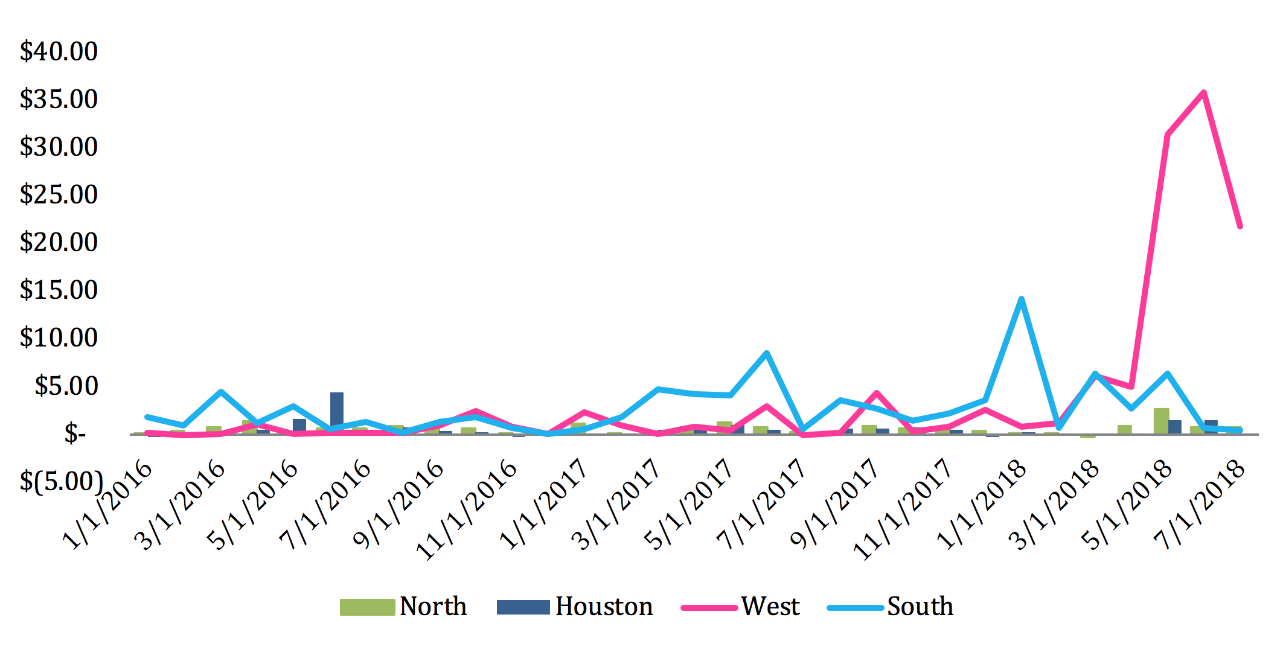
Since energy can only be purchased at the trading hub level to hedge load exposure, customers remain vulnerable to hub-to-load zone pricing differences created by grid congestion. In regions like ERCOT West and South, where grid capacity is frequently constrained and energy demand is high, basis risk is often significant and erratic. In contrast, areas like North and Houston typically experience more stable conditions.
ERCOT hub to load zone congestion ($/MWh)
Understanding the variability of grid congestion by location is critical when evaluating congestion risk and electricity price volatility.
The chart below shows how congestion risk in ERCOT South and West was high and volatile, while North and Houston hub to load zone risk remained relatively mild:
ERCOT Hub to Load Zone Congestion ($/MWh)
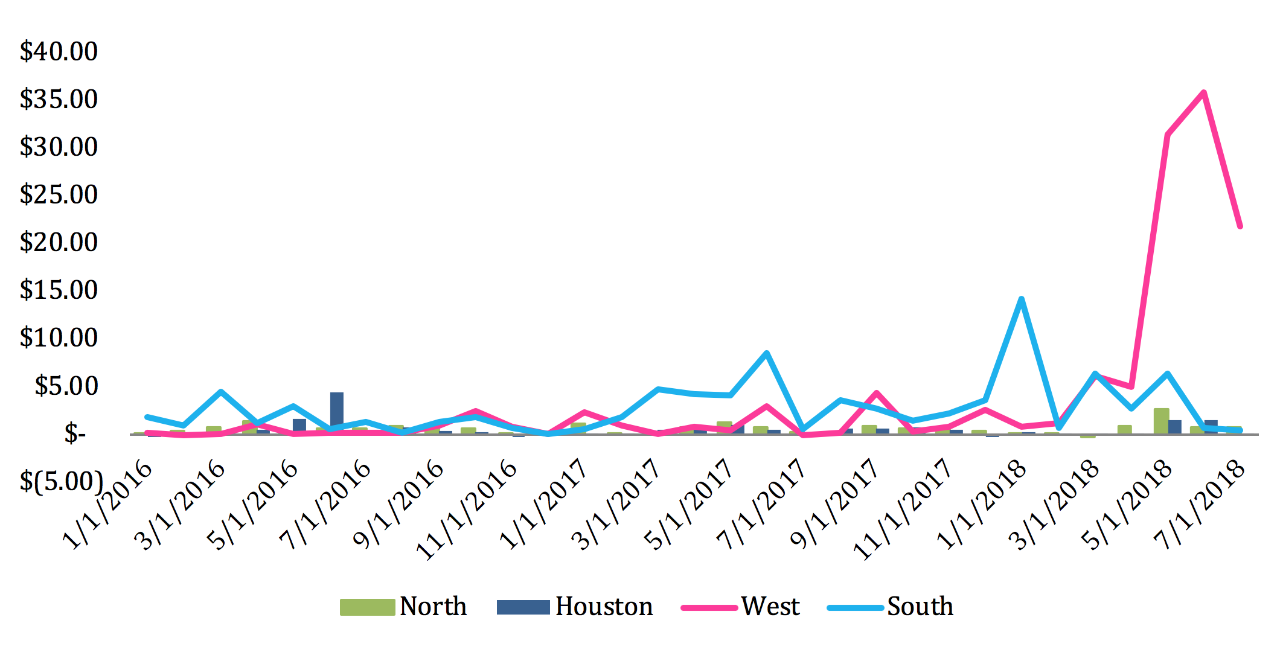
This chart provides a clear example of what managing annual congestion risks can do for a one-megawatt peak load industrial customer with a load of 7,884/MWh in 2018, located in ERCOT West. If the West hub to load zone CRR was purchased in 2017 for 2018 at a price of $3.50/MWh instead of paying the settlement hub to load zone basis of $14.60/MWh, the customer would only have paid $3.50/MWh in 2018. This would have lowered the annual congestion losses from $115K to $27K.
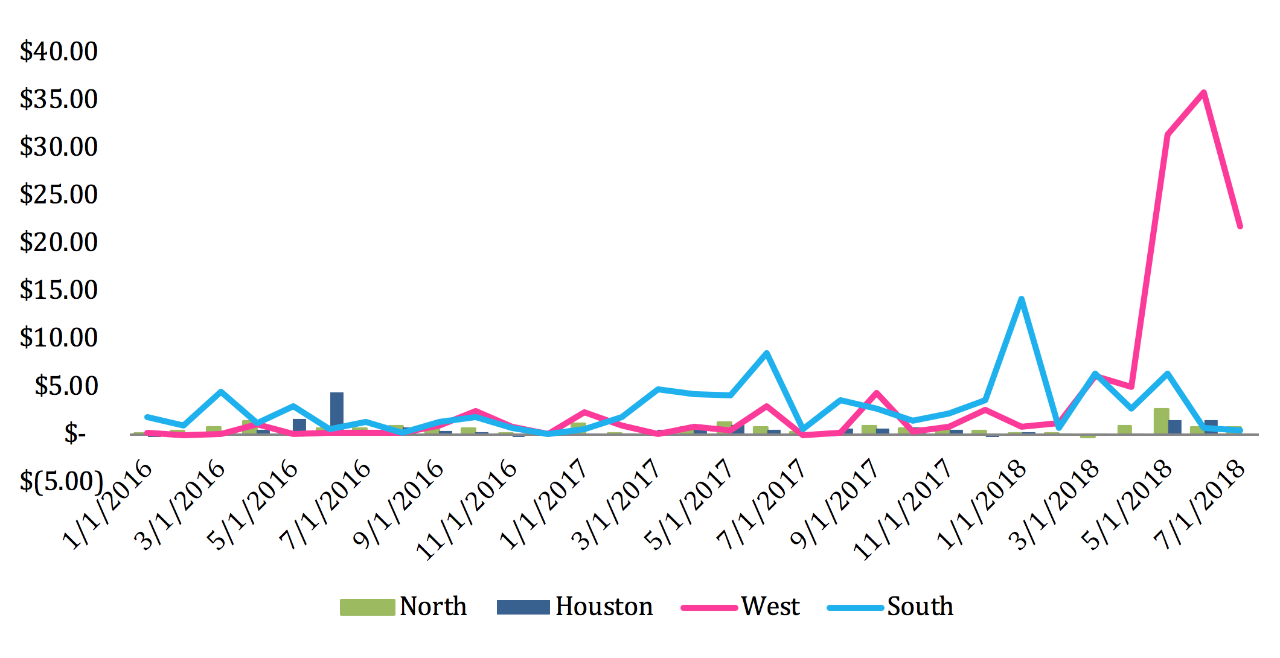
Average congestion ($/MWh)
Reviewing average congestion costs over time helps illustrate the impact of transmission limitations on energy prices and the potential value of hedging tools like CRRs.
The chart below reflects the average hub-to-load zone basis congestion costs across ERCOT zones, highlighting where price volatility has been most acute due to grid congestion and constrained transmission capacity:



Learn to navigate grid congestion
Grid congestion isn’t just a technical challenge — it directly impacts your energy costs, your access to reliable energy supply, and your ability to plan for the future. And while tools like Congestion Revenue Rights (CRRs) can be complex, they offer powerful ways to manage this risk when used strategically.
NRG has deep expertise in these markets. Our team is ready to educate and support customers looking to hedge electricity price volatility and navigate new challenges tied to grid congestion, transmission constraints, and the broader energy transition.
Give NRG a call to explore how congestion management strategies such as CRRs, demand response, or energy storage might help position your business more competitively and reliably.


Share on