








Finding the Right Energy Strategy for Winter
Your business has specific energy goals. We have the solutions to achieve them.
Finding the Right Energy Strategy for Winter
Your business has specific energy goals. We have the solutions to achieve them.
A look back: Global energy in winter 2022
Remember this time last year?
Energy prices were rising, and tight supply and demand balances resulted in significant market volatility.
Last year, European nations prepared for winter by aggressively filling their gas storage, but an extremely warm winter in Europe and North America followed, resulting in natural gas prices dropping and a lack of once-feared price spikes.
Now, as we move into colder temperatures, we’re using what we learned last winter to better prepare for what’s next.
A look ahead: Preparing for winter 2023
As you prepare for a new winter season, we want to ensure you have all the necessary tools to make the best decisions for your specific business. To do that, we need to evaluate the risks and key market factors to look out for. And if your energy contract is expiring, what is the appropriate buying strategy and when is the best time to buy to achieve your business’ goals.
The easiest way to protect against winter price spikes and yield potential savings is with a Fixed Rate plan, but for medium and large energy consumers, locking in your entire price may leave significant value on the table.
So, what’s the best way to access market value while also protecting your budget from unexpected spikes? A layered solution – we’ll explain why.
Layered versus fixed: Understanding your energy procurement options
If you’re looking to optimize both your organization’s energy budget and your opportunity in the market, a layered procurement solution offers the best of both worlds.
With a layered solution, you have the option to purchase part of your energy load at a fixed rate, often referred to as a “layer” or “hedge.” The remaining load stays at a market-based rate until you decide to “layer in” another hedge at a fixed rate. You purchase hedges for months or years out in the forward market or keep the non-fixed portion in the index market.
“Customers lock in a percentage of their load without immediately fixing the entire amount – leaving them open to catch great market prices or change their strategy if better opportunities develop later. Plus, the existing layer reduces the impact of any unexpected market rally,” NRG Senior Manager of Technical Sales, Hans Rottmann said.
Both layered and fixed-price energy procurement are effective at avoiding unfavorable market prices, but only layered purchasing provides the flexibility to continue benefiting from falling prices and potential index market discounts.
If your purchasing goal is simply to meet your budget, a fixed-price solution can help you, as long as the market is favorable. However, if you want to beat your budget and reduce your energy costs, a layered solution gives you a variety of options under any market conditions.
Taking advantage of your energy opportunities
A myriad of factors cause market prices to fluctuate, and expectations or predictions don’t always prove to be accurate. Here are strategic ways to take advantage of winter market declines and defend against volatility.
Natural gas
The two key components of retail gas prices are the New York Mercantile Exchange (NYMEX) and basis. NYMEX Natural Gas is a futures market based on prices for Henry Hub, LA. It is the most traded point in North America and a key point for trading and hedging. Basis prices are the differential between a regional natural gas delivery point compared to the NYMEX.
The two sometimes move together and sometimes they don’t. Since last winter, the near-term NYMEX has fallen sharply while the long-term NYMEX has fallen much more gradually. The result is a change in the shape of the curve, which refers to the relative value of pricing for individual months in the future.
“Near-term prices are now lower due to strong supply and storage inventories, while longer term prices are higher due to bullish market drivers such as increasing LNG exports and reduced drilling activity that could impact supply. So, prices for 2025 and 2026 are higher than the remainder of 2023 and 2024. However, all prices are lower than a year ago, so be careful assuming that higher prices for 2025 and 2026 are not a good value,” Rottmann said.
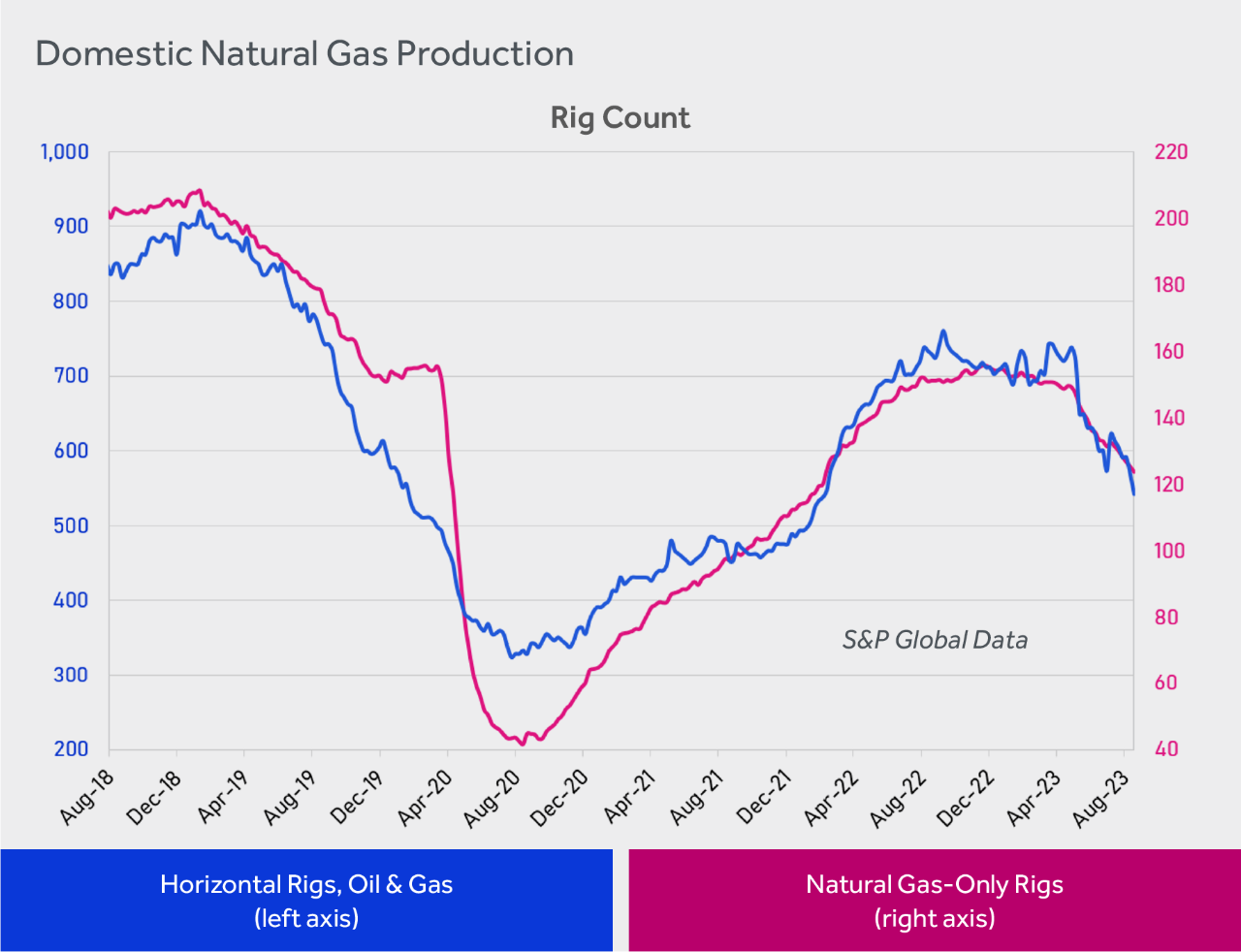
The recent downturn in rig counts can lead to a slowdown in production counts.
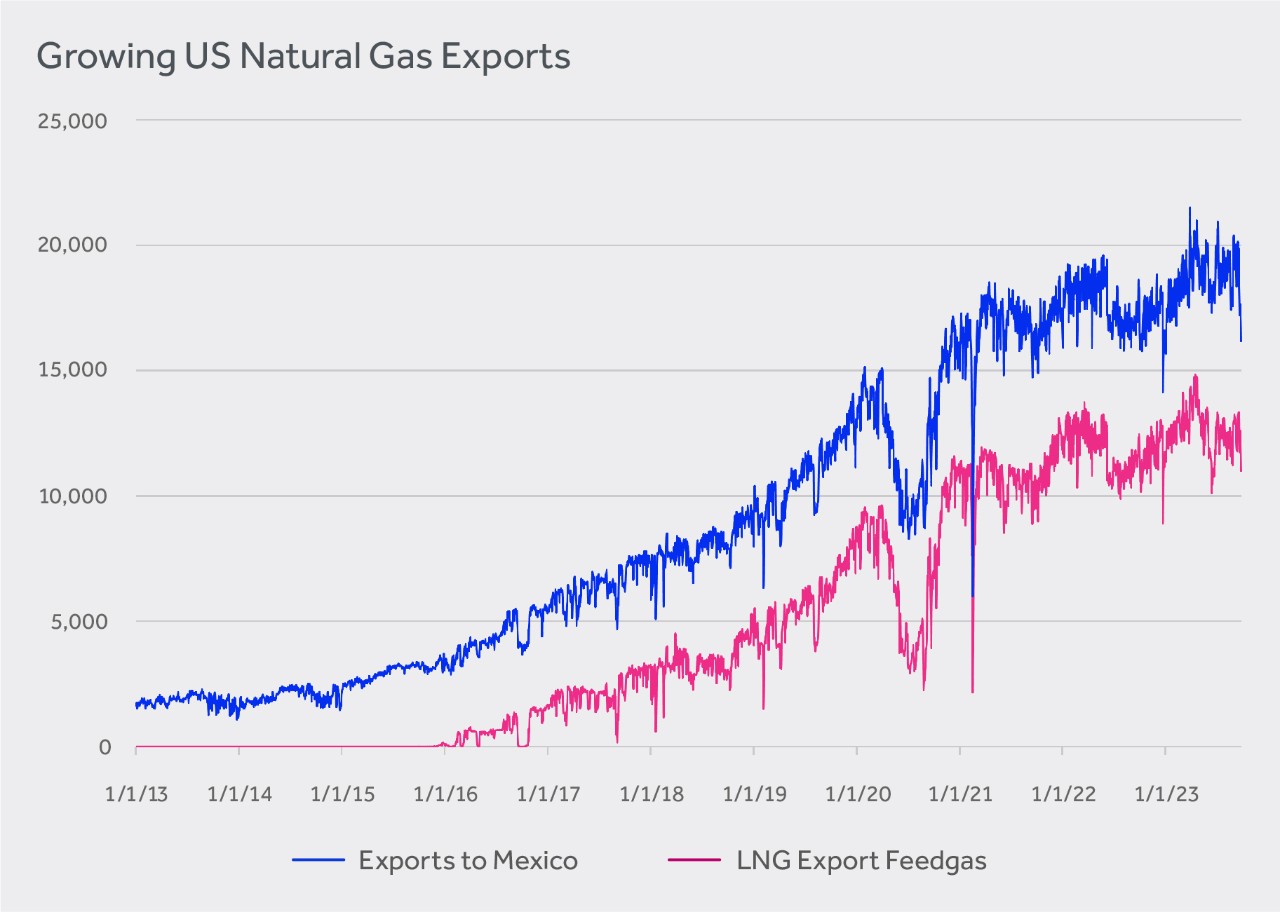
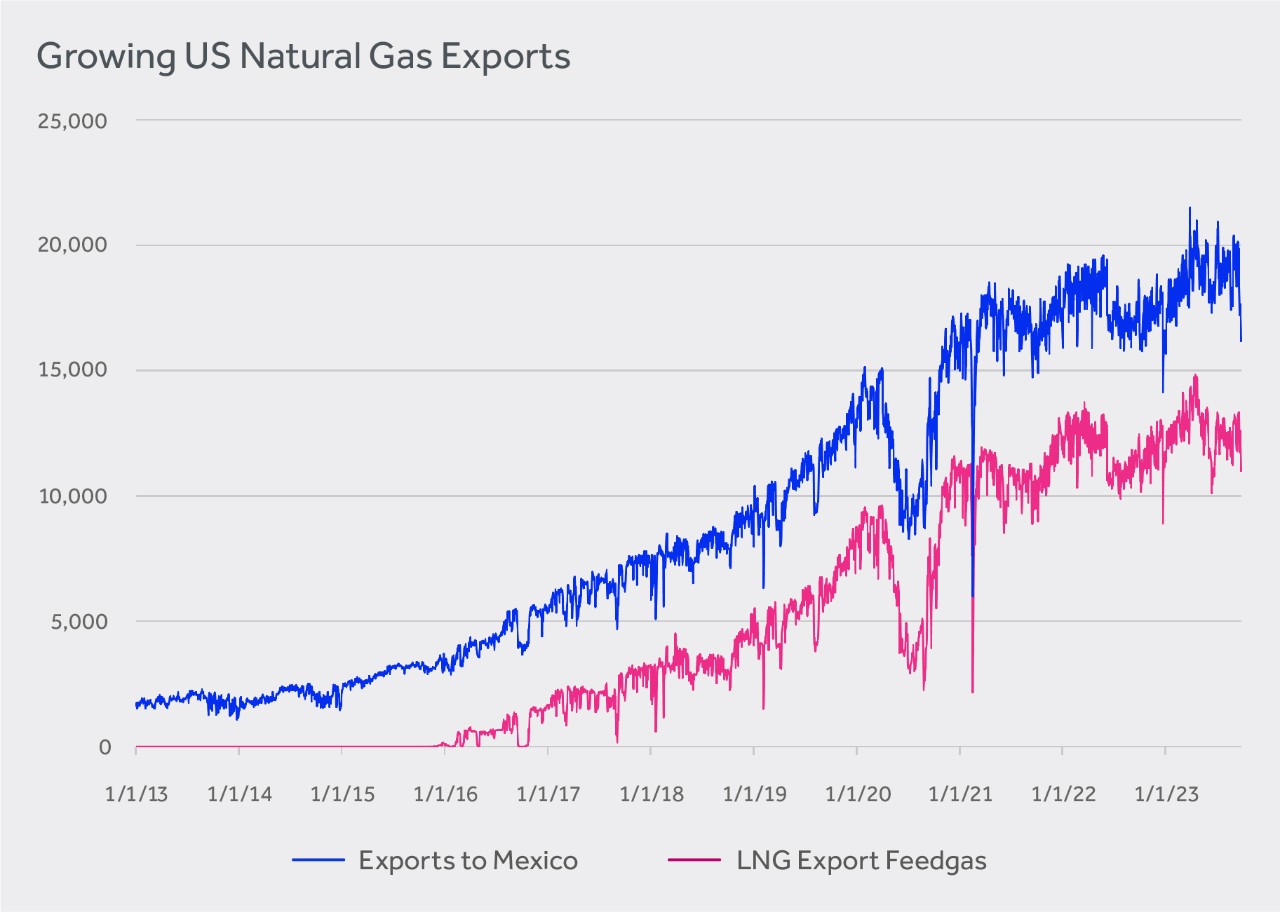
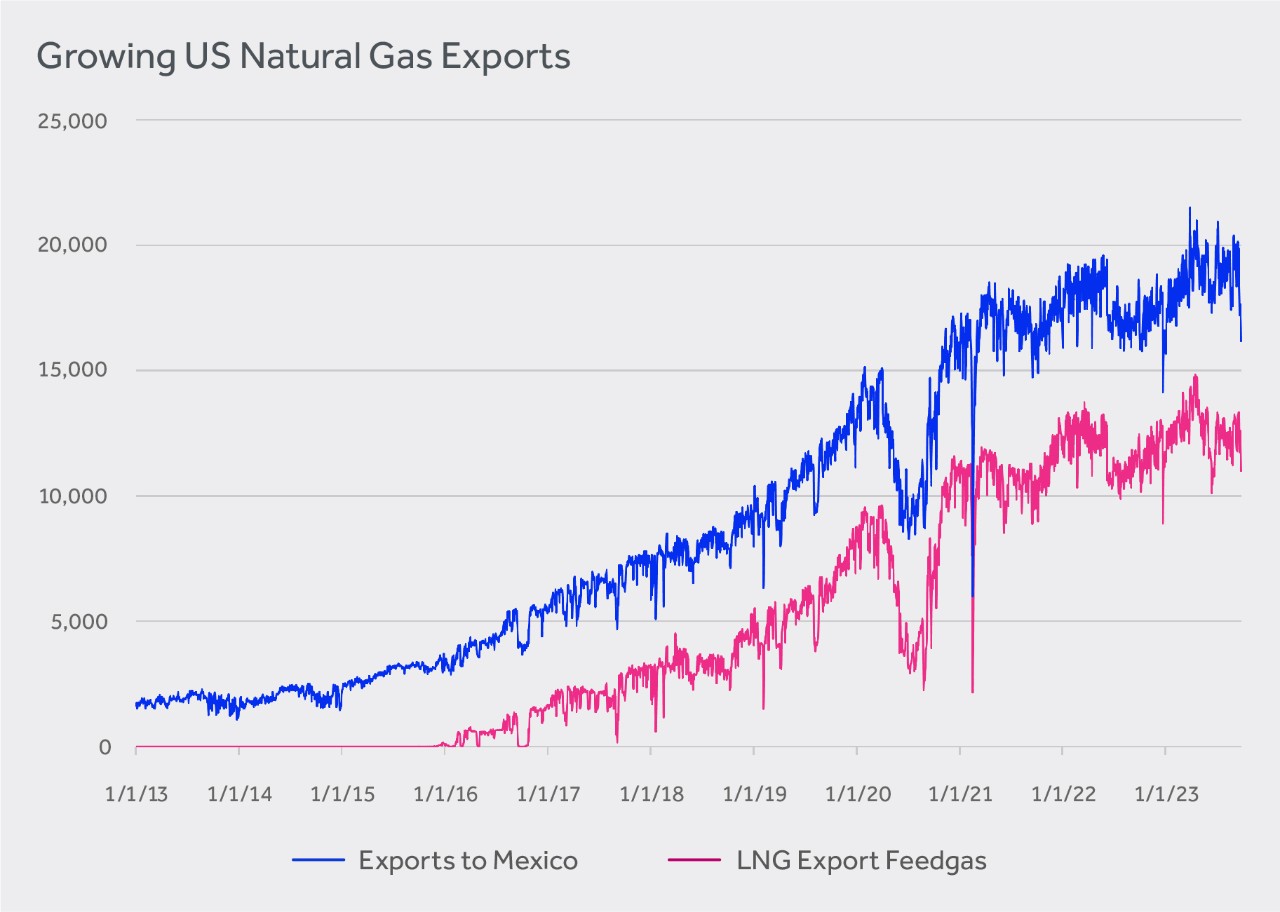
Exports of liquefied natural gas (LNG) continue to drive growth in the U.S. via the Mexican pipeline.
For near-term strategies, NYMEX prices are low and have remained weak since last winter. They could go lower, but the risk is clearly to the upside and certainly warrants consideration at current levels.
For the long-term, NYMEX levels may be justified by the aforementioned bullish fundamentals and could be worth buying – maybe as part of a layering strategy – prior to the risky winter period.
“Remember layering for natural gas can be achieved by fixing the basis in your contract and then gradually layering or ‘triggering’ the NYMEX separately,” Rottmann said.
Finally, don’t forget the basis market. The basis, in some regions such as New England, is much lower than a year ago due to weaker international LNG prices. Other regions have been more volatile due to the ever-changing status of the Mountain Valley Pipeline transporting shale supply from Appalachia to Southeast markets. In Midwest markets, basis remains low and lacks volatility, so the NYMEX may remain your focus.
Electricity
Overall, power prices have followed a similar trend to NYMEX for most markets. Prices are down since last winter with a change in the price curve such that near-term prices are the lowest.
Index prices have been especially low in most Eastern markets, but not in Texas. Some customers hesitate to buy index-priced electricity due to risk and lack of price certainty which is a valid concern. However, index-priced electricity has yielded proven results over a long-term horizon for most markets.
At PJM West Hub, index prices in 2023 have been $6/MWh below the lowest hedging price available to hedge in 2022 and $32/MWh below the average. But index markets can yield volatility as we have seen in Texas this summer – index prices averaged more than $200 for August after averaging $45 in July. We have seen similar periodic volatility in previous years in the East during winter, especially in NYISO and ISO-NE.
If your business is able to handle some fluctuation in your monthly energy cost, consider an index price option to benefit from savings, and remember that layering may still be available. The point of layered purchasing is to lock in value during market dips to insulate your budget enough to confidently weather unexpected market spikes. In short, layering your energy purchases allows you to reduce exposure to market volatility without fixing your entire load.
“If you have the ability to reduce your load on short notice, index products as well as other strategic load management strategies may be a fit for your business,” Rottmann said.
Changing the forward energy curve
One other key change from a year ago for both natural gas and electricity is the shape in the forward curve. Last year, near-term prices were much higher than long-term prices so executing a longer-term contract to reduce your contract price was a potential strategy.
Today, the curve shape is such that long-term prices are higher for most energy markets, so a longer-term contract has a higher price. However, before you assume that a long-term contract is a bad idea, recognize that prices for all terms have fallen and long-term fundamentals such as growing LNG exports and declining drilling activity may push prices higher. These difficult decisions are another reason to consider a layering strategy and to make sure you have a solid procurement plan.
Access expert energy procurement support
The energy market is complex, and if you’re not comfortable navigating it yourself, it’s critical to obtain guidance from an expert who is both tuned in to daily energy market changes and intimately familiar with your organization’s energy profile and goals. Successfully executing layered procurement requires careful decision-making and precise timing. Our Strategic Client Services team can help.
Strategic Client Services is our team of regional energy market experts. They get to know your organization so they can guide you toward the ideal purchasing strategy to meet your goals. Through years of experience and constant real-time market monitoring, our team can help you design a layered procurement strategy that’s unique to your business, so you’ll have confidence over the long term.
Want to learn more about what you can expect this winter? Watch our recent Winter Market Outlook for businesses.


Share on