








A Tale of Two Markets: Incentivizing Long-Term Clean Investments
A Tale of Two Markets: Incentivizing Long-Term Clean Investments
This article was originally published by Travis Kavulla, a former NRG Energy employee, who served as Vice President of Regulatory Affairs.
Adapted from respondent remarks to a presentation by Professor Paul Joskow (MIT) at the Future of Power Markets Forum on November 13, 2020.
Professor Joskow’s contribution to a matter of growing concern — whether the fundamentals of electricity wholesale market design are up to accomplishing the massive transition to a carbon-free power sector — is well timed. But in my view, whether we embark on a “hybrid market” for long-term procurements may depend neither on the scale of climate ambitions nor the infirmities of the fundamentals of wholesale market design. I think the latter can achieve the former, but only if states in their retail regulation allow participants within those markets the space to satisfy customer demand competitively, albeit within the carbon emissions constraints a state may desire to impose.
Put another way, I submit that while much focus has been paid to the wholesale market, it is actually state-based, retail regulation of the sector that frequently is holding back the prospect of greater clean energy deployment. In this vein, let us consider the nature of the wholesale–retail interaction through the vantage point of two experiences, the one in Texas and the one in eastern states.
Texas
First, there is the Electric Reliability Council of Texas (ERCOT). This energy-only market covering most of Texas has one of the highest renewable generation penetration rates in the country. According to the Energy Information Administration, there is already a higher quantity of utility-scale wind and solar in Texas than California, with no sign of renewable investment and development slowing down.
From a wholesale perspective, it is important to note that ERCOT’s “energy-only” market includes an administratively determined scarcity pricing feature that has grown more influential in the past several years. This feature functions effectively as a real-time capacity market that, importantly, values reserves before you’re in the reliability ditch. It is not appropriate to think of ERCOT as an energy-only market without understanding this important qualifier.
While it is true that the market itself remunerates that capacity only during its actual deliveries of energy during hours of scarcity, the market design does affect forward prices. Additionally, the regulatory decisions of the Public Utility Commission of Texas about the level to set the loss of load probability (LoLP) and value of lost load (VoLL) are highly influential on forward prices and on ultimate settlements.
On the retail side, those responsible for buying energy to supply customers in ERCOT are, with the exception of a handful of municipal utilities and co-operatives, entirely competitive retailers who stand to gain or lose profit on their procurements. This is profoundly different from the retail landscape even in other restructured jurisdictions, where the abiding role of rate-regulated utilities in supplying customers has entrenched them as the biggest retailer in any market, which can afford to be indifferent to the price it offers customers or to the eventual cost of the goods it sells, thanks to trackers and reconciliation adjustments.
Retailers in Texas come in many different stripes. Let me speak only to what we at NRG are doing, because our actions (and our customers’ wants) have directly led to renewable energy deployment in a couple of ways.
First, we have signed a series of long-term power purchase agreements (“PPAs”) in ERCOT – totaling approximately 1,700 MW with third-party developers and other counterparties. In these arrangements, NRG agrees to be the off-taker at a fixed price, providing revenue certainty to the project and helping the developer secure the financing needed to get the project built. NRG assumes the risk that the PPA’s price will diverge from the market price of energy over the term of the PPA, while the project owner (or another proxy) takes the “merchant tail” risk for the value of the project’s generation from the conclusion of the PPA term forward.
Meanwhile, our retail portfolio is made up of primarily short-term residential contracts, with some longer-term agreements with large customers. We expect to have load to serve even if it is not contractually obligated to us today, so we are comfortable with a portfolio approach that includes signing longer-term PPAs.
This retail contracting dynamic leads to huge quantities of resource entry. According to ERCOT, it is expected that roughly 6,000 MW of wind, 8,000 MW of solar, and 1,300 MW of battery storage will come online in 2021. Even in the event of a price on carbon, or the implementation of an aggressive clean electricity standard, there is no indication that the ERCOT market design would not be able to handle it.
As the marginal supply resource has become an intermittent renewable one—or perhaps a battery—ERCOT is also a market that has rewarded the adaptation of the demand side of retailers’ ledgers. ERCOT has an extraordinary rate of voluntary price-responsive demand product adoption in the United States, with a little less than one-fifth of all customer count, according to the PUCT’s annual demand response reports. Again, this can be traced back to a business model that provides financial incentives to reduce and flex load when the wholesale price exceeds the retail contract price.
The East
Let us now move from Texas east and north to the restructured markets of the eastern Regional Transmission Organizations. In these markets, we lack the same incentives that exist in ERCOT to make long-term investments.
The reason is pretty simple. In these markets, a competitive retailer’s biggest competition is not its peers but a rate-regulated “default service provider”— always, it so happens, the erstwhile incumbent monopoly—that cannot lose.
All of a default supplier’s costs are recovered through regulated rates — even to the point of truing-up losses in past intervals if the price offered to customers did not produce enough revenue to cover the cost of goods sold to them. (Competitive retailers who screw this up eat those losses, and consequently price their products to reflect this risk.) The magnitude of this phenomenon will become still greater with time because, everywhere, the default product is a fixed-rate retail offer; as wholesale pricing grows more volatile with the addition of intermittent renewables, a fixed-price retail offer made by a rate-regulated entity that bears no financial responsibility to “cover” the likely volatility in the wholesale market will gain an ever larger advantage over those competitive retailers who must bear this risk.¹
Putting to the side the systemic inequity of regulated and competitive pricing in these markets, most successful competitive markets are designed to encourage people to actively shop. That frequently is not the case in these retail markets.
The utility still possesses about two-thirds of the residential and small commercial market because it is hard to shop. I recently moved and even though I was served by the same utility before and after that move, I was defaulted back onto the utility’s default service. I once again exercised my right to choose the electricity plan that best fit my needs, not the default plan from the local monopoly. The process of establishing service at my new residence to finally being served as a customer of the competitive retailer took an astonishing 75 days.
Finally, state lawmakers in these states tend not to show the same consistency of vision that Texas has when it comes to the market. Competitive retailers, on occasion, have made long-term investments in renewables in the East, only to see them devalued through grandfathering provisions that don’t allow retailers to count those procurements towards the latest iteration of renewable portfolio standards that the state adopts.
If retailers are not seeing a keen environment for investment, how about the utilities themselves? They too are not overly eager to simply take on debt to their balance sheets by being the public policy vehicles for long-term procurements — unless they are a utility with a generation affiliate or associated transmission capital expenditure that can be packaged together as one.
What that means for today’s energy market
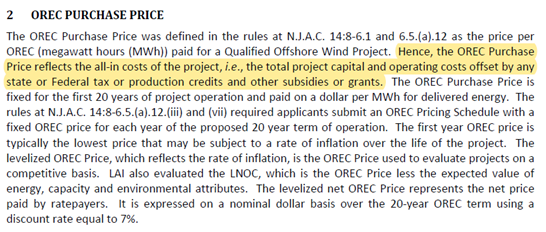
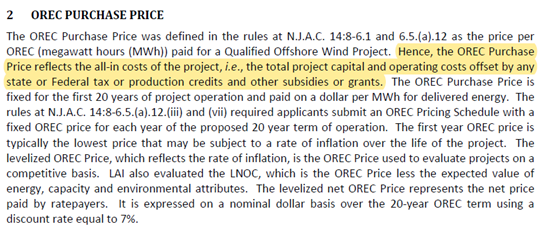
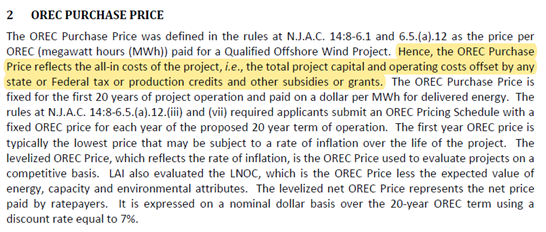
This leads to what we are seeing today, which is a kind of “hybrid market” where the wholesale market optimizes whatever resources happen to be online, but what is online is poised to become, yet again, a function of government decision-making. We are seeing a new era of big, new, state-sponsored projects, with customers on the hook should those projects go south. And while these plays are often gussied up as “competitive procurements,” they often are not. Take New Jersey’s process for securing offshore wind as an example. Instead of a competitive process, New Jersey invited applicants to submit applications to be evaluated ad hoc. This is essentially a return to “revenue requirement” regulation. Though evaluated using benchmarks, you have a set of three distinct applications for PPA treatment with a price ostensibly set at the project’s cost, net of other subsidies.
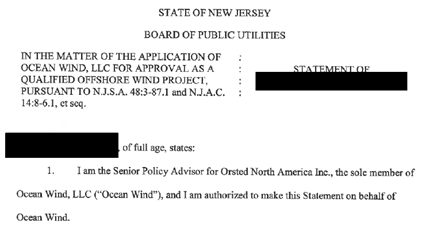
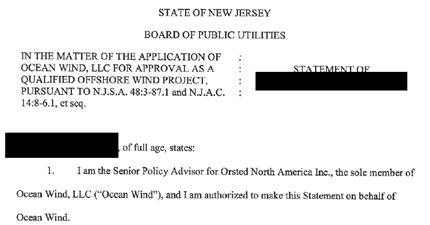
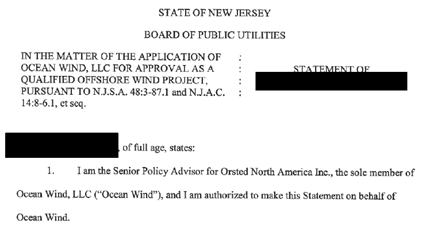
But unlike the utility regulation of old, which involved a single, closely regulated actor, having to open its books and answer the extensive questions of other parties, the presence of several applicants for favorable status by the government results in just enough competition to give color to an argument that these arrangements should be considered commercially sensitive and off-limits to the public. Thus, the truly marvelous artifact below is a screenshot of the first page of the supporting affidavit of one project’s application to the regulator, where the name of the affiant was judged to be a trade secret and redacted.
How can renewable energy projects help?
We should not accept the premise that retail competition is doomed to fail. It is ironic that states, recently in a position of discontent about the FERC-jurisdictional wholesale market’s failures to produce clean energy, have at their disposal the exclusive jurisdiction to regulate retail markets. These retail markets, as Texas indicates, could be powerful tools to further investments in clean energy.
Previous efforts to eliminate utility-provided default service in these markets have nearly succeeded. Why not give it another go? A reform that replaced the customer’s default supplier and replaced it with a more competitive market could stimulate significant bilateral investment. A competitively neutral price on carbon or trade-in clean energy credits could easily be layered on top of this model—indeed, even making it more attractive to new entrants for the market’s expected churn and growth.
However, if we come to a place of resignation and believe only more direct state interventions are plausible, I would offer a handful of cautions to a long-term contracting approach that has the state, which is to say, taxpayers or captive customers, take on much of the risk of the eventual value of procurement.
It is often suggested as a virtue that state sponsorship of projects will reduce the cost of capital. I agree that eliminating the risk to investors will reduce the cost of capital. But surely this begs the question. First, I question the perception that these are big buckets of fixed costs in which the only variable is cost of capital. There are actually a number of decisions a project owner, or properly incentivized off-taker, would be making that would be dampened by a design in which the government off-taker assumes risk including:
- The location at which to build a resource to maximize value of energy and capacity
- The decision on how to hedge a project’s energy and capacity output
- How to posture in renegotiating contract terms (for example, delayed commercial operation date as a result of COVID-19 for a lower PPA price)
- How to repower
- How to provide newly valuable ancillary services with additional equipment.
Second, it is worth noting that across the sector, the cost of capital is historically low, even for projects with significant risk exposure in ERCOT.
As we consider hybrid markets, I would champion a market design that allows for clean energy projects to become merchants in the sale of the products they produce. Such a design could be achieved through a market that permits the separate sale of clean energy attributes, possibly coordinated with capacity. This would retain a model that currently exists in the eastern markets and has put much of the risk back where it belongs: on the investors who choose to make a bet. In such a construct, clean energy developers would be in the position of estimating likely future energy, ancillary services, and perhaps capacity revenues while making an offer of the “missing money” associated with the clean energy premium. An example of this is the Forward Clean Energy Market that Kathleen Spees previously presented to this forum.
¹It is incrementally better to have unregulated wholesale suppliers to the regulated default provider bear this risk, and thus price it in, but that typically still does not achieve parity for at least two other reasons. Transmission cost fluctuations, made more profound by FERC’s formula ratemaking that result in annual changes, are likewise passed-through by the default provider, even while they must be borne as a risk by competitive retailers. This is rich, since the result is the transmission-customer side of a utility being held harmless by the cost increases imposed by the transmission-service side of the company, even while competitive retailers — again — stand to lose. Finally, the substantial overhead costs of running this default business frequently are shunted to the poles-and-wires charges of the utility — again, an unlevel playing field.
¹It is incrementally better to have unregulated wholesale suppliers to the regulated default provider bear this risk, and thus price it in, but that typically still does not achieve parity for at least two other reasons. Transmission cost fluctuations, made more profound by FERC’s formula ratemaking that result in annual changes, are likewise passed-through by the default provider, even while they must be borne as a risk by competitive retailers. This is rich, since the result is the transmission-customer side of a utility being held harmless by the cost increases imposed by the transmission-service side of the company, even while competitive retailers—again—stand to lose. Finally, the substantial overhead costs of running this default business frequently are shunted to the poles-and-wires charges of the utility—again, an unlevel playing field.


Share on