











Summer Energy Market 2024: Prices, Trends and Buying Strategies for Businesses
Summer Energy Market 2024: Prices, Trends and Buying Strategies for Businesses
Summer is here and depending on where you’re at with your business’ energy buying strategy, you may be hoping for a cooler-than-normal forecast. If you’re still solidifying your plans, here is a quick update on market fundamentals and some approaches to consider for your buying strategy heading into the hot season.
The bulls and the bears of the energy markets
There are a lot of factors that can impact power and gas markets—each of which could potentially put upward or downward pressure on prices. Let’s have a look:
Weather
When temperatures rise, so does the demand for power, therefore having some insight into the weather may help predict what could happen with electricity prices. Also, certain weather conditions increase the likelihood of a more active Atlantic hurricane season, which can be disruptive to energy markets, including to energy production, generation, transportation and transmission.
Last summer we moved into El Niño conditions, which favor a warm, dry North and a cooler, wetter South with fewer Atlantic hurricanes. Current forecasts are calling for La Niña conditions by summer, continuing into the fall. La Niña conditions typically indicate warmer and dryer summer weather and a more active Atlantic tropical season. An interesting fact: according to NOAA, since 1950, every summer in the “top 10 warmest” has occurred since 2010, with summer 2023 sliding in as the 10th hottest on record.
Bearish factors
Bullish factors
|
Natural gas
Power markets can be closely correlated with the natural gas market since natural gas is a key power generation source in most regions, however, this correlation has weakened in some regions due to the growth of wind and solar generation. Understanding gas fundamentals can provide some insights into power price trajectory and help with natural gas purchasing decisions.
With another above-normal winter (the warmest Dec./Jan./Feb. on record, dating back to 1950) and steady production at the beginning of winter (hitting a record high of 106 Bcf/day in December), the natural gas market is over-supplied. EIA gas storage is at a significant surplus to the 5-year average, finishing withdrawal season (March 2024) at 2,275 Bcf. These bearish factors are keeping near-term prices low but may be unsustainable. Bullish factors are putting pressure on long-term prices, resulting in a contango gas market.
Bearish factors
Bullish factors
|
Regional market fundamentals
CAISO:
Coming off a mild winter, California has a gas storage surplus when compared to historical levels, resulting in favorable near-term power and gas prices and low index settlements over the last year. Drought conditions, which are a serious concern in this region, are at normal levels and in-state hydro conditions are above 100% of the average.
Bearish factors
Bullish factors
|
PJM & MISO:
Energy prices are lower overall compared to the Northeast due to access to cheaper gas supply. A changing generation mix and gas infrastructure updates are having different regional impacts.
Bearish factors
Bullish factors
|
NYISO & ISO-NE
Generation plant retirements, electricity and natural gas exports, pipeline constraints, and oil costs all have an impact on New York and New England energy costs.
Bearish factors
Bullish factors
|
ERCOT
Over the last few summers, peak net load has become more expensive to serve as dispatchable supply has not kept up with load growth. That trend is expected to continue this summer as the peak net load fundamentals have only minimally improved year-over-year. Forward prices for this summer are at or near all-time highs, and summer prices beyond this year have recently strengthened significantly given the potential future load growth from residential, AI, crypto, LNG projects, and hydrogen facilities.
Bearish factors
Bullish factors
|
Summer energy buying strategies and considerations
Similar to 2023, the gas market is in contango going into summer, but near-term pricing has seen more severe declines from last year, and pricing for some forward terms is also lower than it was last year at this time. Near-term declines were primarily driven by the warmest winter (Dec./Jan./Feb.) on record and a storage surplus, resulting in reduced summer gas demand for storage refill. Gas basis and electricity prices however are not trending exactly the same as NYMEX.
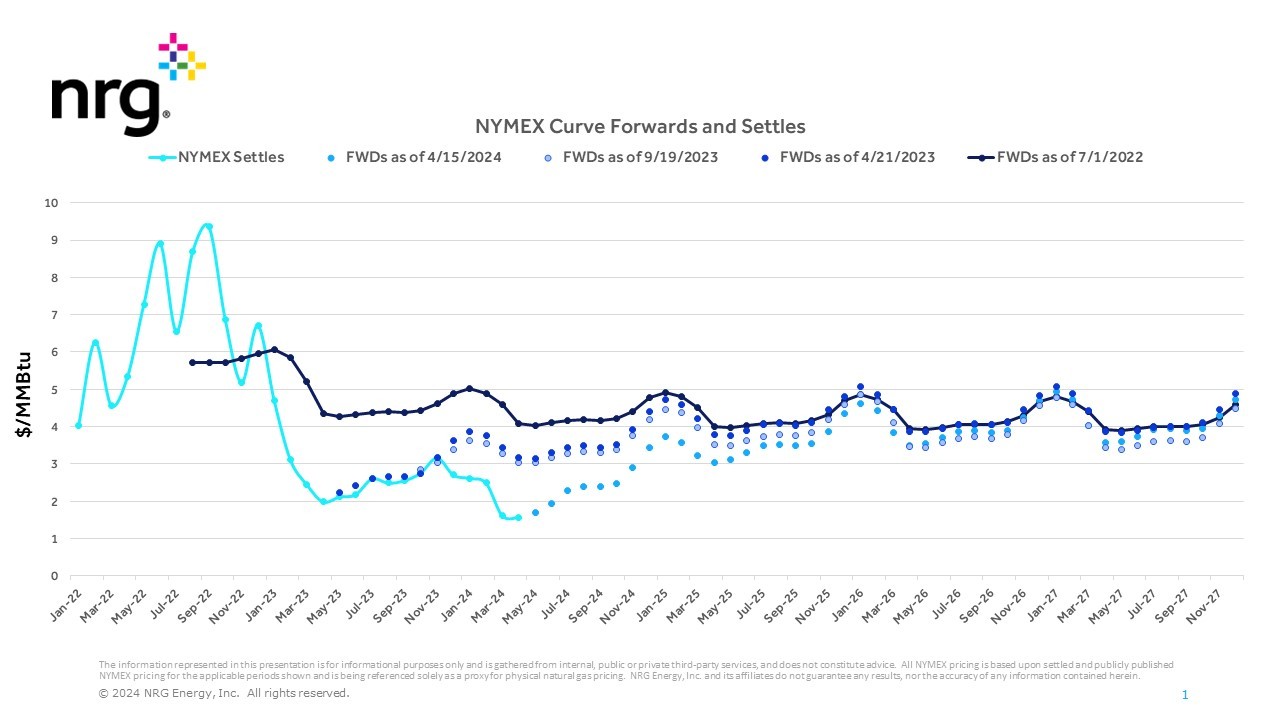
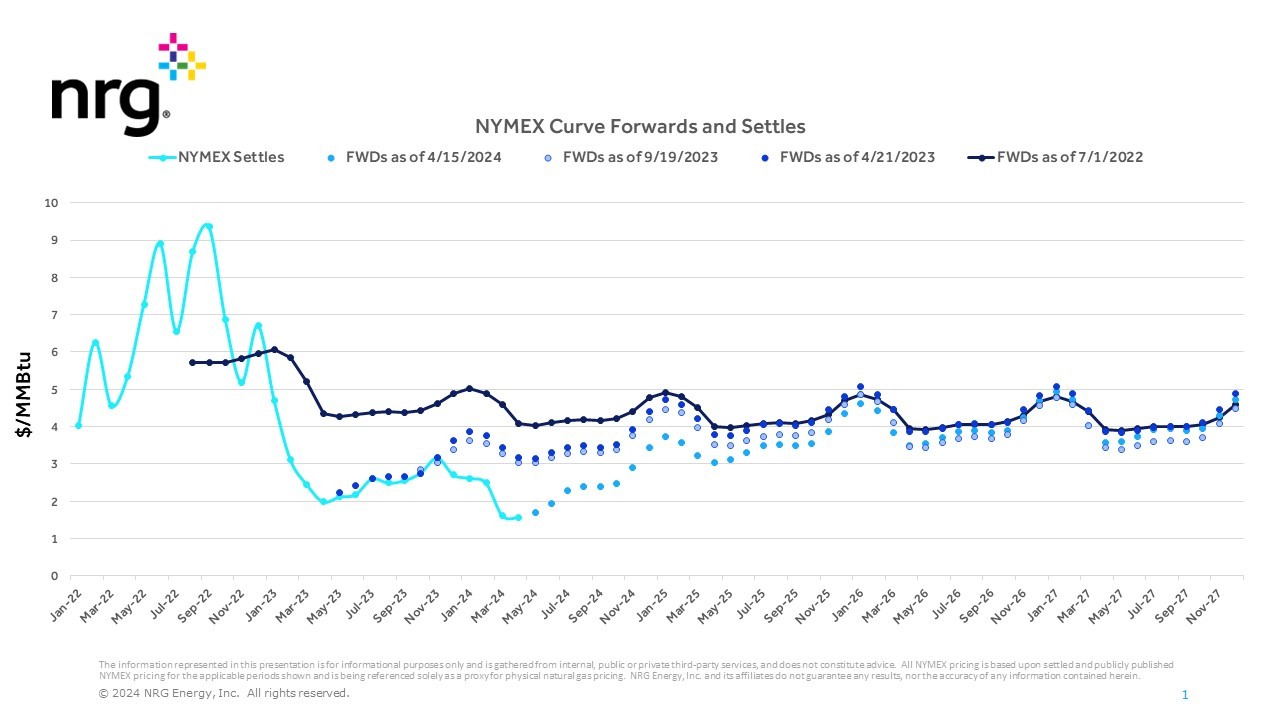
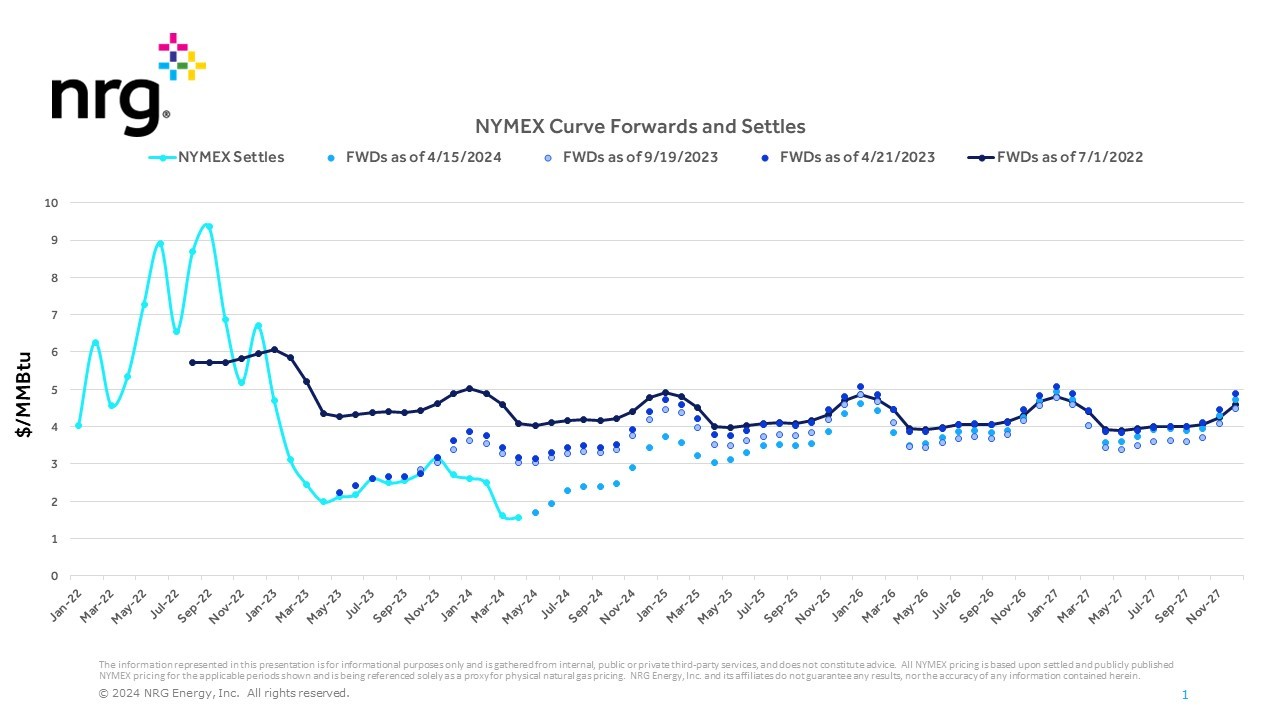
In ERCOT North Hub, forward prices have been on a consistent up-trend and are now in modest backwardation — a disconnection from the contango of the NYMEX market. This disconnection can be attributed to the increased reliance on non-dispatchable generation, such as wind and solar, in this region, which has also made index prices vulnerable to periodic extreme price spikes. Most forward price terms were more favorable in April 2022 than they were in April 2024 — except for Q4 2024 and Q1 2025, which were showing some value this year compared to the last two years.
Eastern power prices are a mixed bag — not discounted as severely as near-term NYMEX, but not moving up as rapidly as ERCOT power forwards. Index prices have also been consistently weak across the region.
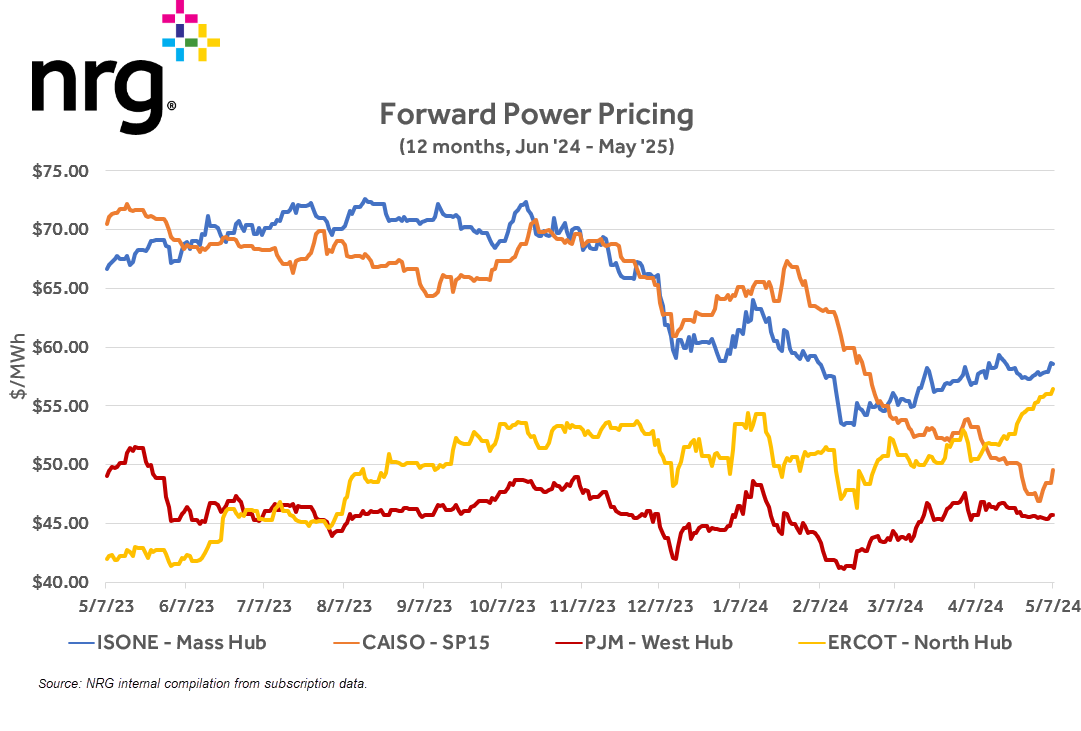
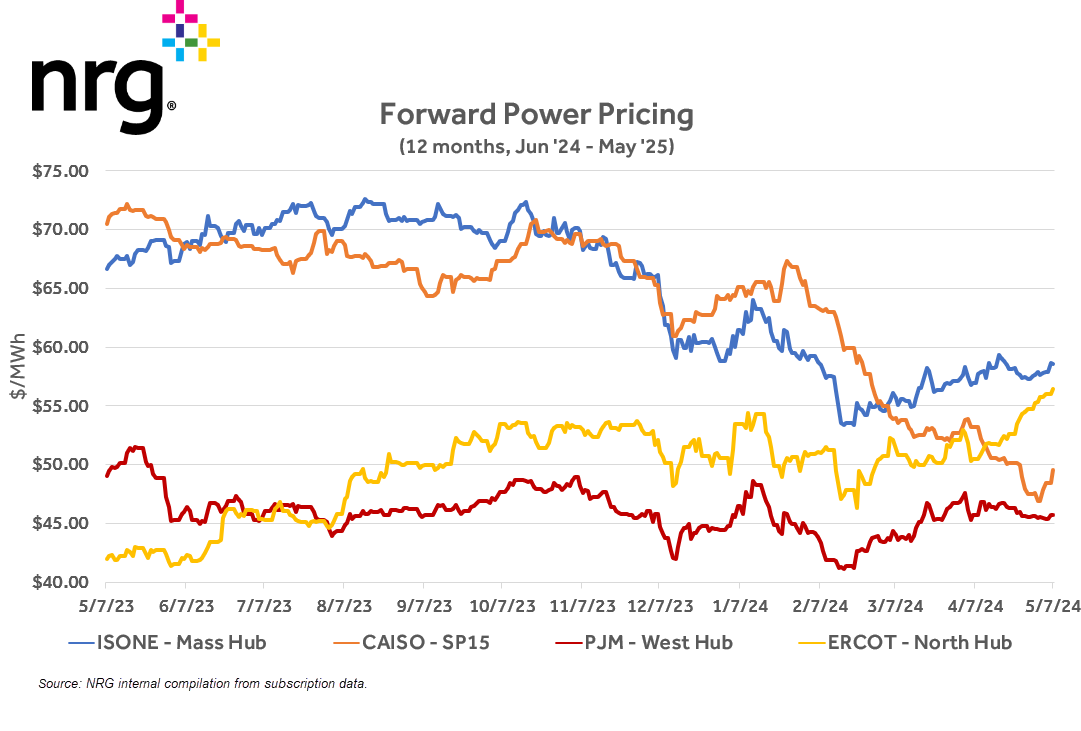
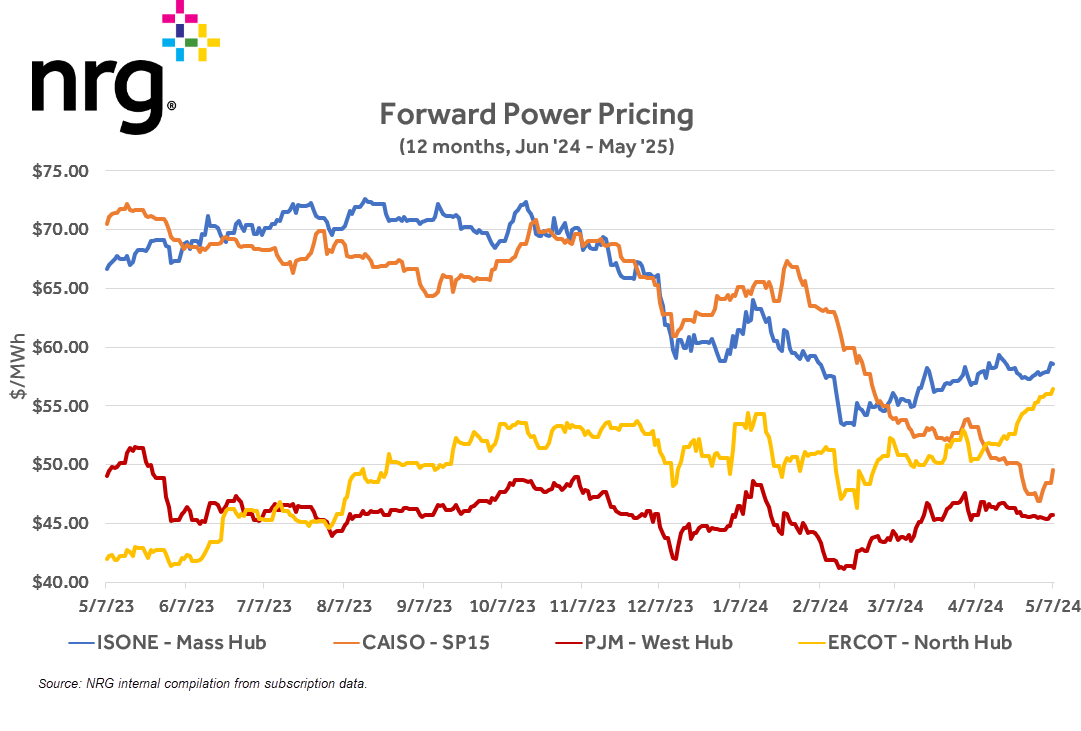
In NYISO Zone J (NYC) in particular, the forward curve has shifted to a more severe contango than a year ago, as 2024-2025 prices are severely discounted — and index prices have also been weak. Higher long-term prices, compounded with bullish risks from a changing electric grid, make strategy decisions more difficult beyond 2025. While somewhat different this same conundrum applies to PJM and ISO-NE as well.
So, we ask ourselves, is it smart to buy long-term in this contango market? Here are some things to consider:
Currently
- Even though long-term NYMEX prices are higher than near-term, they have fallen since last year coming out of a warm winter/over-supplied market.
- Extremely low near-term prices are driven by short-term factors, such as weather and storage, that may eventually normalize and have a diminished impact.
Into the future
- LNG exports are growing and producer cuts to production could continue to tighten the supply/demand balance for gas.
- Continued generation retirements and increased reliance on intermittent generation resources can tighten supply/demand fundamentals, causing price volatility during hot weather.
- The expected dramatic demand growth from data centers is having a bullish impact on power forward curves — especially for 2027 and beyond.
Regional hot buttons
- PJM/NYISO capacity and PJM transmission costs, along with growing data center demand
- ERCOT peak demand vs. resource availability (with increased reliance on renewables)
- New England’s ongoing limited access to gas supply as well as aggressive renewable standards
- California gas imports from Texas being diverted to LNG facilities
- Gas basis: long-term basis is relatively weak and for most eastern markets. Basis for some markets for 2025-2028 is relatively flat.
With these details and your unique load profile in mind, some strategies you may consider:
- ”Waiting to lock in" has worked, as near-term prices have continued to fall, but should you continue to rely on a strategy that has been largely driven by bearish weather and overabundant supply?
- For electric, also consider a hybrid strategy whereby you can lock in some of your requirements to help protect your budget from full exposure to potential summer price volatility, while also having the opportunity to capitalize on lower market index prices that may continue to show value over hedges. Be sure to evaluate various retail adder components, which vary greatly by region. Fixed versus pass-through costs such as capacity, transmission, and renewables can have a dramatic impact on your costs.
- For natural gas purchases, consider the looming upside risks in power burn demand, production curtailment, and increased exports. Also consider regional basis nuances. A potential strategy in a contango market where basis pricing is low could include the NYMEX Plus product. With this product, you can lock in a longer-term basis then immediately trigger higher percentages of your gas supply for the lower-priced near-term, with a more gradual triggering strategy for the longer-term portion of your contract.
- For markets like PJM and NYISO, where non-commodity costs are comprising a much larger percentage of your supply rate, consider a strategic load management program that can help you lower these costs by lowering your capacity and transmission obligations.
- If you have the ability to shift load (i.e. when you use power), you may qualify to earn money for curtailing—either through a regional demand response program or NRG’s own proprietary Responsive Economic Dispatch (RED) program.
We invite you to talk to your NRG Account Executive or Energy Strategist to explore your customized strategy options and to find out more about energy services and programs that can help you earn money or lower costs. You can also keep a pulse on changing market conditions and fundamentals with our Daily Market Update or hear what our experts had to say in our Summer 2024 Market Update webinar.
Don’t sweat your energy strategy this summer — we’re here to help you identify the best strategy for your business.
NRG Energy, Inc. (along with our affiliates, “NRG” or “we”) makes no representation or warranty, express or implied, as to the accuracy or completeness of the information set forth in this document, and we shall not have any liability to any person or entity resulting from use of this information in any way. This information is provided for informational purposes only, and it is not (and it may not be construed as) an offer to enter into any transaction. In addition, this information is not (and it should not be viewed as) recommending or advising on a particular result, strategy, or trading decision in any market.

Share on