











Thought about Summer Electricity Prices? We Have.
Thought about Summer Electricity Prices? We Have.
Big changes may be afoot in the Texas wholesale power market this summer. For thriving and sophisticated businesses in Texas, now is the time to evaluate energy planning and risk management – in fact, these two factors have more in common than most might think.
It’s hard to predict where energy prices will go, but analysts see potential increases ahead for customers within the electric market known as the Electric Reliability Council of Texas (ERCOT), which is the grid operator for 90 percent of the state’s electric load.
In short, after years of historically low commodity prices, several large power plants recently retired due to economic pressure. Construction of new generation has also slowed. By ERCOT’s measure, spare capacity will run extremely low this summer, largely as a result of the retirement of 4.7 GW of power plants.
Most of the retiring generation is fired by coal and owned by Luminant, a subsidiary of Vistra Energy. Luminant says that the plants — the 1.8 GW Monticello, 1.1 GW Sandow and 1.2 GW Big Brown — are no longer economic to run, partly because of pressure from competing resources, such as natural gas-fired power plants and renewable energy.
In addition, ERCOT’s 2018-2027 report on capacity, demand and reserves (CDR) describes delay in building three planned gas-fired resources, totaling 1,193 MW, as well as several renewable energy projects totaling 3,488 MW. A 500 MW wind energy project was canceled altogether.
In all, ERCOT expects a 7,200 MW decrease in overall generation capacity for summer 2018 compared to its May 2017 forecast.
Meanwhile, Texans’ demand for electricity continues to grow at a strong pace. As a result, ERCOT forecasts the lowest reserve margin ever in the history of the market for a first-year projection.
Think of the reserve margin as the cushion of power-generating capacity available for when electricity demand surges high. ERCOT historically had a target reserve margin of 13.75 percent. However, ERCOT only forecasts a reserve margin of 9.3 percent of surplus generating capacity for summer 2018. By way of contrast, reserve margin forecasts have run as high as 43 percent for first year projections. It’s also important to note that the 9.3 percent reserve margin represents a 9.6 percentage drop in where ERCOT thought it would be in its May 2017 forecast, according to the CDR report. This represents a significant market shift.
How does this affect businesses and the price they pay for electricity?
Like sugar, cotton and corn, wholesale power is a commodity. And as such, its pricing is subject to market forces. When demand nears supply, prices will rise. Electricity is particularly vulnerable to price volatility because, unlike other commodities, it cannot currently be stored in meaningful quantities. So as electricity becomes limited prices can rise.
Impact of Low Reserve Margins on Pricing
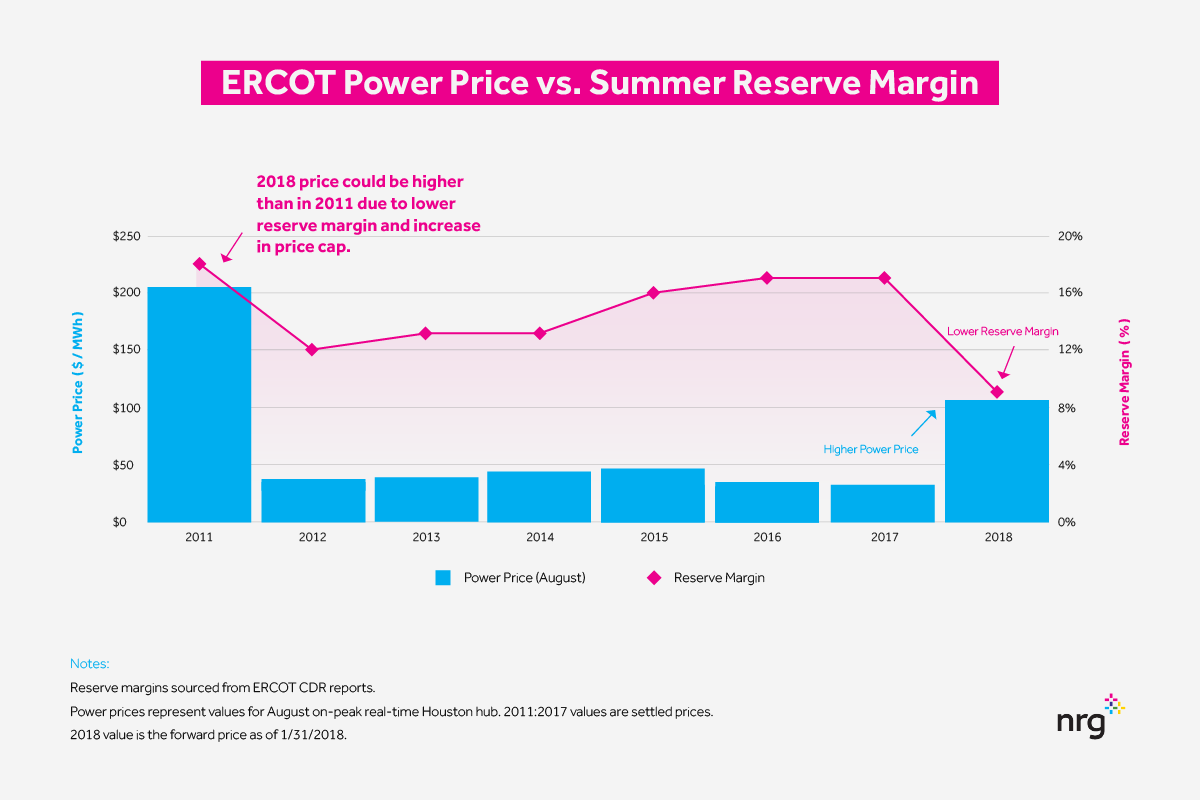
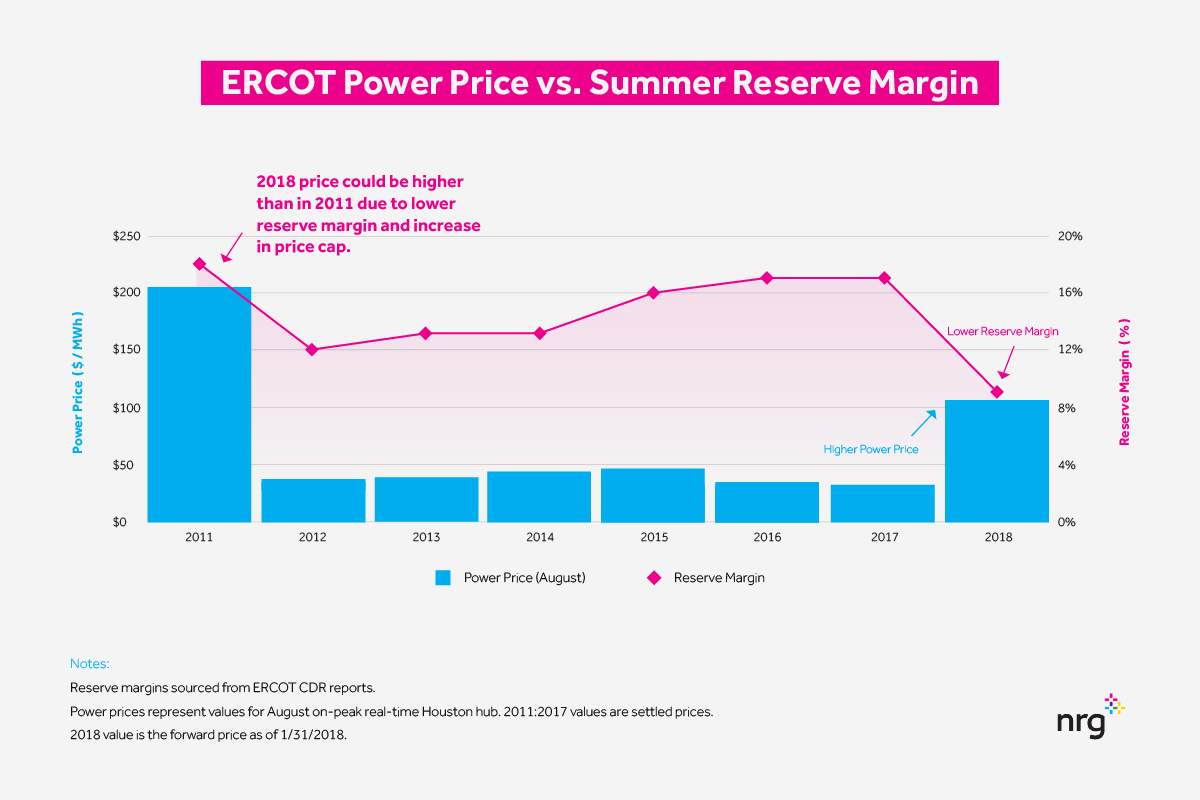
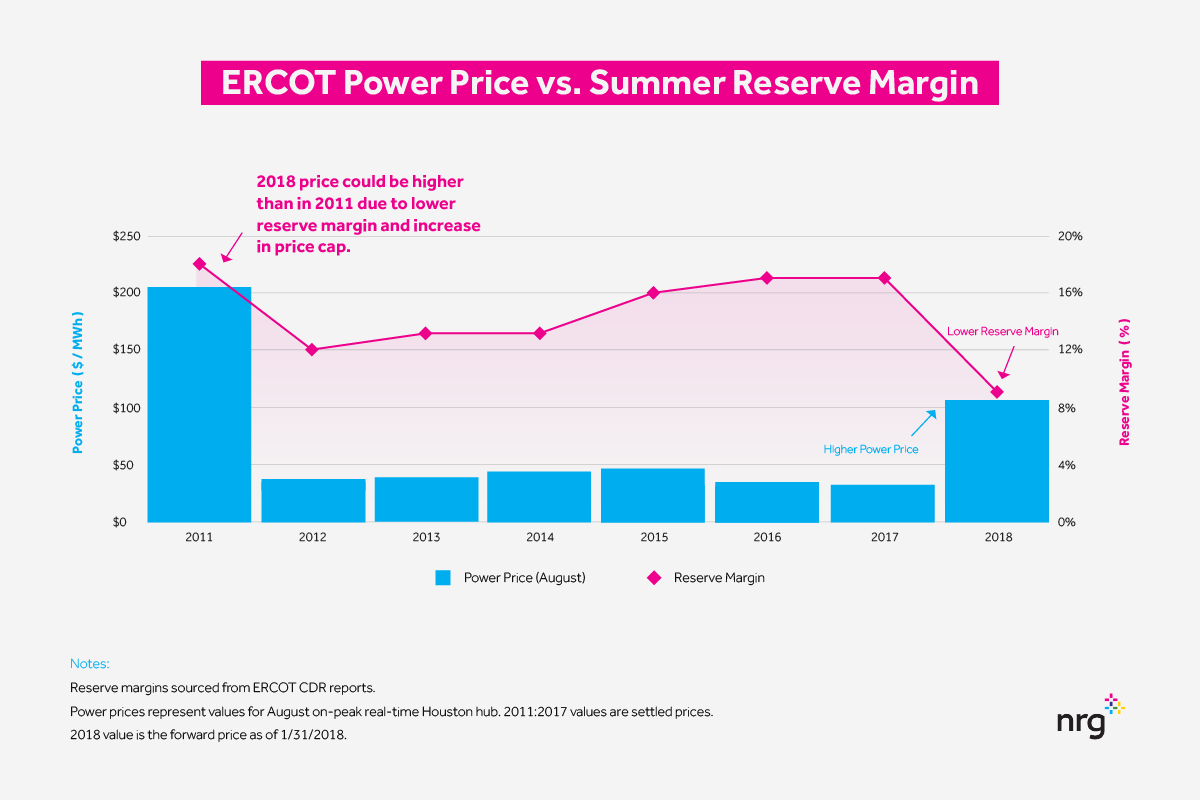
Due to relatively high reserve margins (i.e., significantly greater supply than demand) and mild weather, wholesale power prices have been low for several years. The chart below shows that during the period 2012-2017, reserve margins averaged 15% and wholesale power prices for August averaged a very low $38/MWh. The last significant pricing event in ERCOT was in 2011, when extreme heat across the state drove prices to an average of $200/MWh despite a healthy reserve margin.
2018 is different than prior years, however, due to the forecasted low reserve margin. Currently, the price of the August 2018 forward contract is close to $100/MWh, already three times higher than historical daily August prices over the last few years.
Influencing the potential for high prices is an increase in the ERCOT price cap. In 2011, the maximum allowable price was $3,000/MWh; in 2018, the price cap is $9,000/MWh. The higher price cap is meant to ensure that resources are available to meet needs; more specifically to discourage plants from retiring early and incentivize developers to build new plants.
The increase in the price cap combined with the low reserve margin substantially increases the risk of high prices relative to prior years.
The Time to Act Is Now
The past few years of low electricity pricing may have made companies complacent, less inclined to take a second look at energy costs and instead focused on priorities related to operating their businesses.
“It is precisely these kinds of circumstances when commercial and industrial businesses run into trouble with their energy bills,” said Scott Hart, Vice President of Commercial and Industrial, NRG. “They may not realize the value of evaluating their energy hedging strategy well before market prices rise. Instead, they discover the problem after they open their bill, when it is too late.”
That’s why NRG encourages companies to review their electricity contracts and take action now — helping save money and boosting their bottom-line.
Who Is at Risk
Businesses with fixed-price contracts have the least exposure to real-time market prices. But even they face risk from spikes in real-time prices that may impact future fixed rates.
As for businesses with electricity contracts indexed to real-time pricing, they can reduce risk — and continue to enjoy the upside when prices fall — by working with their electricity supplier to arrange a contract with elements of real-time and fixed pricing. These products are known as Block and Index Products, and are customized to a business’s risk tolerance.
Beyond modifying their electricity pricing structures, businesses should explore additional energy solutions that will help them achieve a more comprehensive energy strategy. A more comprehensive energy strategy in most cases results in greater efficiency and yields long-term savings. Through demand response programs or a distributed energy solution, a tailored energy approach to fit unique needs will help businesses prosper in changing market conditions.
So what exactly should Texas businesses do now — and over the long term? Given these market conditions, it’s important the take the necessary steps now to prepare for the upcoming summer months. This requires that businesses take an integrated view of their energy supply and demand strategy:
Evaluate their risk appetite against their current electricity contract structure.
Work with their retail electricity supplier to evaluate alternate structures to mitigate that risk — if the risk of unpredictably high prices this summer or in future years is too high.
Consult an energy provider to better understand how solutions like demand response programs and distributed energy resources can help increase efficiency and yield long-term savings.
The Big Picture
Higher prices resulting from a lower reserve margin will incentivize new supply to come to the market. But that takes time as new generation development is a multi-year process.
Meanwhile, pressure grows for more power in Texas, with the state’s population increasing by almost 400,000 people in 2017, the highest addition among states, according to the U.S. Census Bureau. Further, Texas’ job growth topped the nation in June 2017. Given this backdrop, any business that hasn’t done so should consider re-evaluating its electricity contract right away.
The market is changing. Businesses need to take the necessary steps to prepare for the upcoming summer months. NRG has the expertise — from generation to end-user — and decades of market experience to serve as a trusted partner for electricity cost management.


Share on