








Empower Customers to Shop and Let Industry Bear the Risk of Energy Price Volatility
Empower Customers to Shop and Let Industry Bear the Risk of Energy Price Volatility
This article was originally published by Travis Kavulla, a former NRG Energy employee, who served as Vice President of Regulatory Affairs.
Wholesale natural gas prices are projected to go up 86% higher than one year ago, according to the Energy Information Administration’s Winter Fuels Outlook, with some places looking at even higher increases.
How—and if—these increases will impact consumers depends on the policy choices that state legislators and regulators have made. Specifically, new research suggests that a crucial step in protecting customers from price spikes is to empower them to shop for their own energy supplier.
A new report—Beyond Texas: Evaluating Customer Exposure to Energy Price Spikes: A Case Study of Winter Storm Uri, February 2021— supports this approach. The paper takes a deep dive—across 15 states—into power and gas costs during a time of extreme volatility, evaluating who ultimately footed the bill during the significant price spike seen last winter. The full report is available for download.
Its findings are significant.
- The typical residential customer of a utility-monopoly affected by the February 2021 price spike will end up paying hundreds of dollars for a single week’s worth of gas or power. In some cases, that total runs upwards of $2,000, for combination gas and electric customers in highly impacted states that offer no customer choice for either sector.
- As one utility executive put it, “higher natural gas prices are pass-through costs for our business [and] they did not impact this quarter’s utility results” in terms of corporate earnings. When customers are given the right to shop, they can ditch suppliers who increase future prices to recoup past losses. In utility-monopoly markets, customers can’t do that, and regulation in this case serves as a vehicle to ensure the monopoly’s financial outcomes, at the expense of customers.
- The largest competitive market for retail customers, Texas, saw most residential customers insulated from price volatility through fixed-rate, term energy plans. Texas energy providers who offered these plans are responsible for managing their businesses’ energy costs, and those who did not went out of business.
The public policy conclusions from this case study are twofold
First, states should allow customers to shop. It is a competition that prevents a monopoly’s captive base of customers from being treated as an insurance policy when bad things happen. Proponents of utility monopolies often cast their arguments in terms of customer protection; at least in this context, that is fiction. Further, additional research shows that despite the higher costs, utility monopolies in Texas didn’t outperform competitive generators when it came to reliability.
Second, states that do allow shopping should encourage customers to actively do so. Given the potential volatility of natural gas prices this winter, consider purchasing a fixed-price, term contract. That kind of contract won’t be right for every customer, but it is an option that shifts the costs of a market-driven price spike to energy providers—the ones with commercial expertise buying and selling energy—and away from the consumer.
It’s never a bad time to consider your options. When I did so myself about two months ago, I found a great deal.
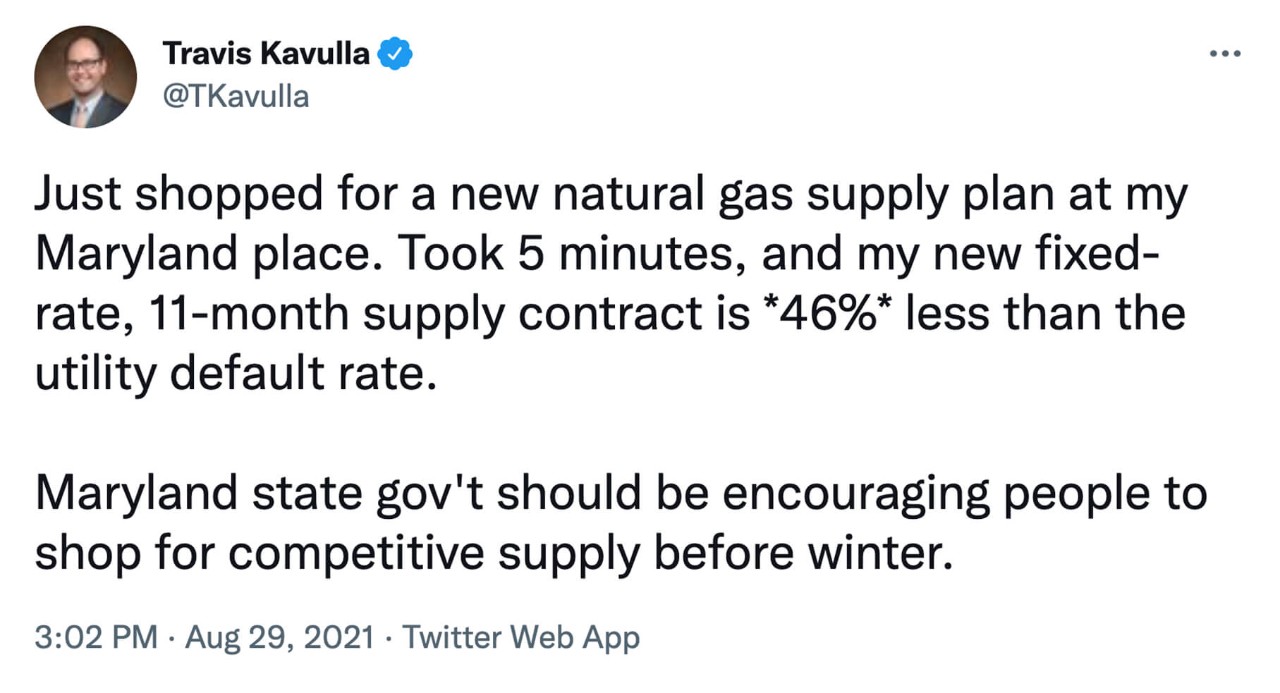
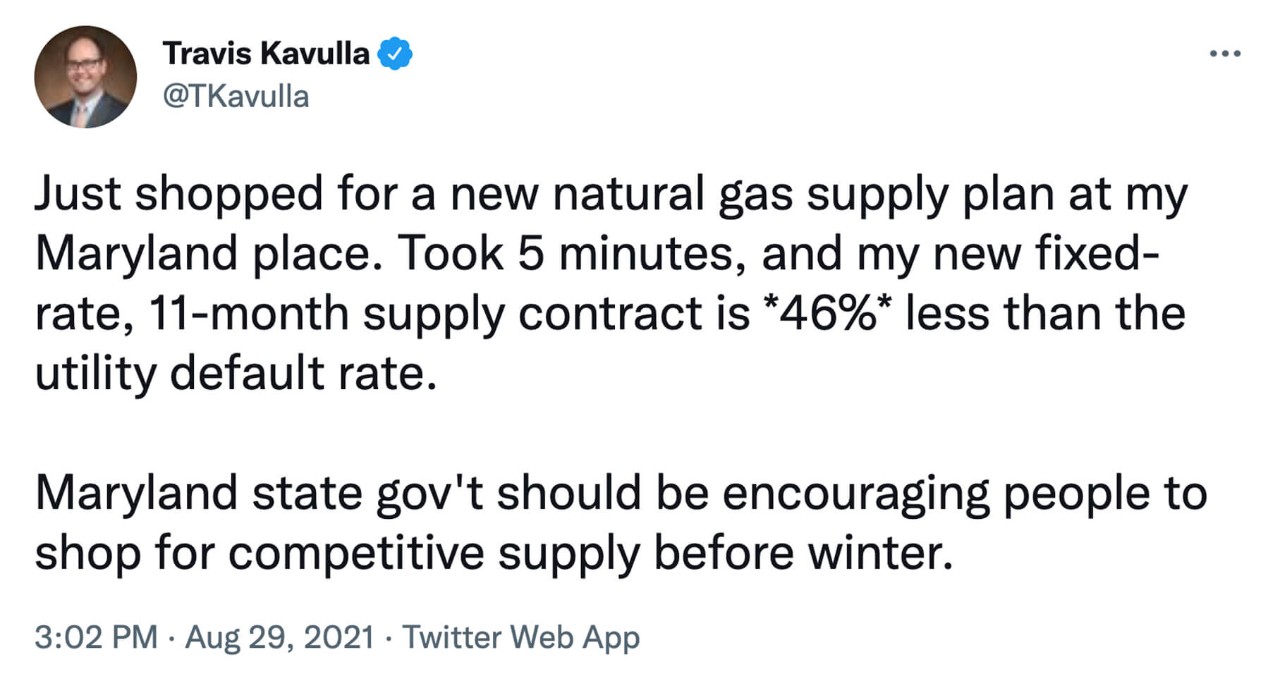
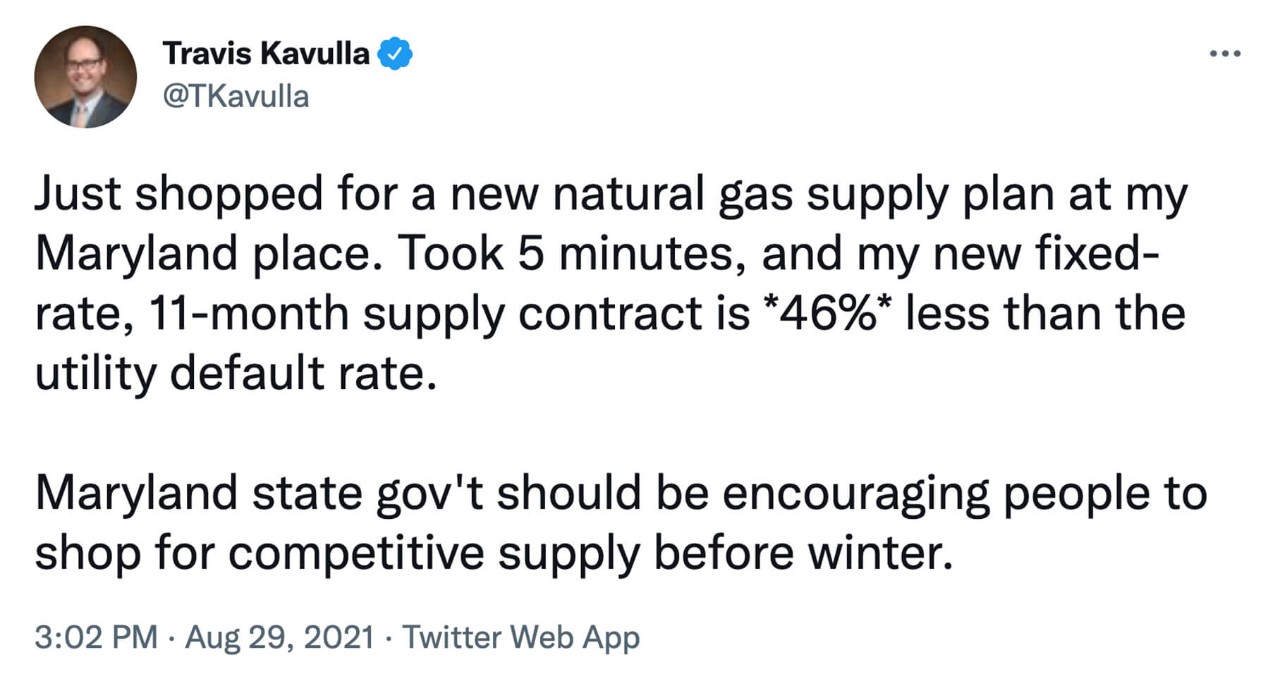
As gas prices continue to rise, the deal I got seems even better in retrospect
A good deal is not about guaranteeing savings. It’s about having the option to pick a plan that suits my risk tolerance. If I did not shop, I would be served by the “default” utility, which adjusts its gas costs every month. With the uncertainty around natural gas prices, I’d rather not have unpleasant surprises when I open my bill.
As winter approaches, policymakers and regulators in the 16 states and provinces that allow residential electric customer choice—and nearly double that number for natural gas—should consider encouraging their citizens to look at their options. Some jurisdictions have set up shopping websites to facilitate this, including Maryland, Pennsylvania, and Texas, which have some of the best sites available. For Canadians, Alberta has an excellent shopping site.
Wherever you live, consider your options, and take comfort in the fact that you can take control of your energy and choose the plan that’s right for you.

Share on