








Clean. Competitive. Customer-focused.
Creating an open market optimized for the future
Clean. Competitive. Customer-focused.
Creating an open market optimized for the future
Competition fuels innovation. It’s an age-old adage that still holds true, even in today’s complex global marketplace. For decades, this belief has propelled American industries. Take any recent innovation and it’s a likely result of vigorous, open competition. Smartphones sprung from an ultracompetitive deregulated telecommunications sector; e-commerce was born and has shifted the entire idea of retail; and the ferociously competitive auto industry has seen continued advances in safety, along with more than a dozen fully electric models now on sale in the U.S.
Here at NRG, we operate primarily in competitive energy markets. This competition benefits our customers in much the same way it has in other industries, allowing us to provide new and exciting products and solutions for our clients.
Competition and retail electricity markets
ERCOT Retail
One of the primary markets we do business in is Texas, where the Electric Reliability Council of Texas (ERCOT) is the independent system operator, managing the flow of electric power to over 25 million customers. ERCOT’s competitive marketplace fuels innovation and provides three main benefits:
- Choice — Multiple energy providers give customers a range of alternatives to choose from, including tailored payment and pricing plans, and emerging renewable energy options
- Convenience — Customers can effortlessly control their energy usage with appliances and thermostats that deliver seamless automation
- Insight — Customers can become more educated about their energy usage with web portals, mobile alerts, and continuous energy monitoring
A hallmark of the ERCOT market is transparency, as exemplified by the direct relationship between energy retailer and energy customer. There are more than 100 retail electric providers operating in a highly competitive environment, where earning market share is the direct result of these providers offering innovative products and services designed around customer needs. Each retailer is responsible for meeting each customer’s needs — from enrollment, to energy suppy, to billing — and educating them along the way.
PJM Retail
When we look at the Northeast, the situation is markedly different. Here, the retail energy supply industry’s ability to deliver innovative products to mass market customers has been limited, impacting those from the Midwest to New England and down into the Mid-Atlantic region. Default supply service provided by incumbent utilities is replete with barriers to competition.
For example, more than two decades into restructuring, basic fundamentals remain unresolved. These include the ability to easily enroll customers, directly bill them, and allow them to choose a preferred supplier when establishing service for a new residence, or to retain their service provider when moving. Further, market transactions in the East are managed by the competitive retail industry’s competitors — the incumbent utilities.
Regulators and policymakers need to recognize the difference between the legacy, incumbent utilities and innovative, modern-day retail energy service providers. These providers are not public utilities; they are a free-market alternative, providing a multitude of innovative and cost-effective energy supply solutions customized for specific needs. Removing the current barriers to fair and open competition will improve the ability of consumers to select the energy solution that’s right for them. Whether that decision is to move to a new innovative free market product or stay with the incumbent utility, the choice should be with the consumer.
Wholesale markets
ERCOT Wholesale
A true competitive market also responds appropriately to market factors and conditions. During the summer of 2019, ERCOT saw the benefit of competition. ERCOT is an energy-only market, with no capacity payments. Capacity payments compensate power generators so they can operate when needed, whether they operate infrequently only during the peaks or every day to ensure there is more supply available than demand. Without capacity payments, power generators have to survive on what they earn in the energy market. Previously, low energy prices were prevalent due to plentiful generation supply, but that scenario reversed last summer when conditions tightened, and prices went up. Higher prices arising from tight reserve margins send signals to generators to retrofit existing facilities, bring plants back online, or even build new generation. This market response acts to moderate prices and maintains a reliable electric system without putting undo risk on consumers. The marketplace followed the basic principles of supply and demand — ensuring sufficient energy supply — both traditional generation and renewables.
PJM Wholesale
In PJM (and the Northeast in general), there is a very different situation developing. With last century’s nuclear plants being openly subsidized in several states, the competitive environment that reflects the region’s energy needs is becoming distorted. Nuclear subsidies create numerous adverse results for the market and its customers. For example, competition and innovation in the market is hindered, stifling the development of new renewable resources like wind and solar. Also, consumers paying for first-generation nuclear plants get less carbon-free power for their money than they otherwise could. Rather than letting the market develop to deliver value to customers, pricing and other regulatory decisions are constricting its natural evolution, which can lead to more expensive, outdated outcomes for customers.
Comparing U.S. electricity prices
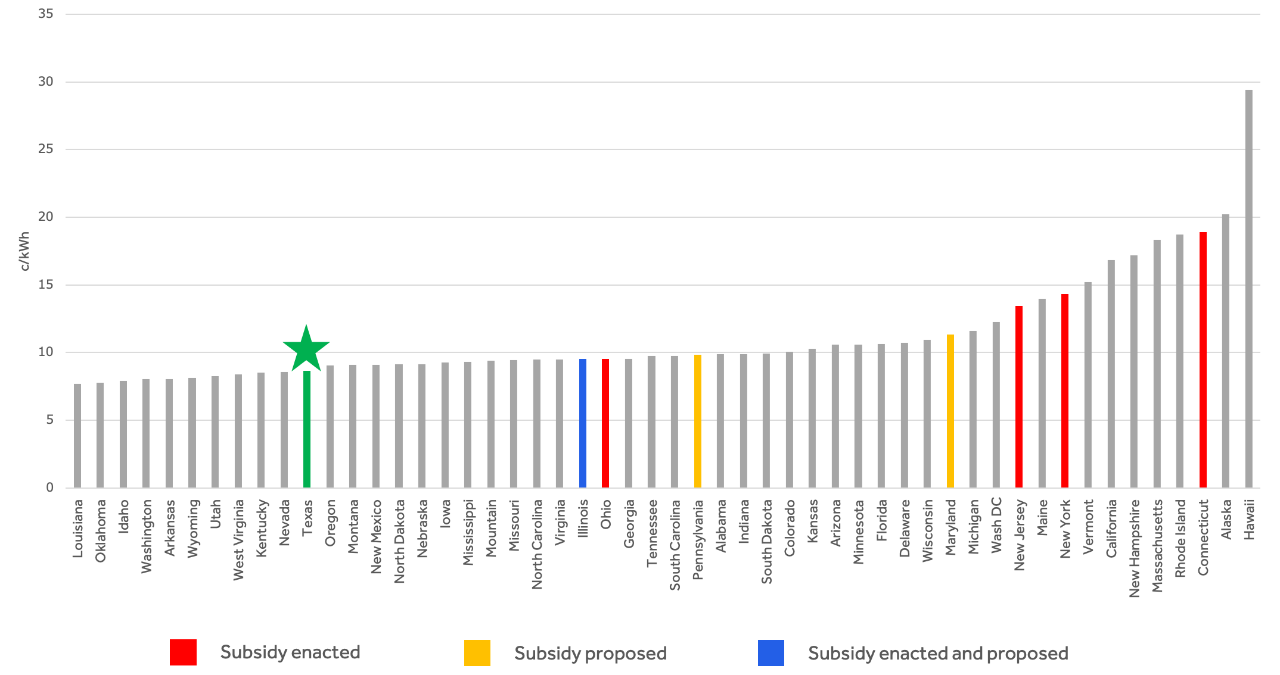
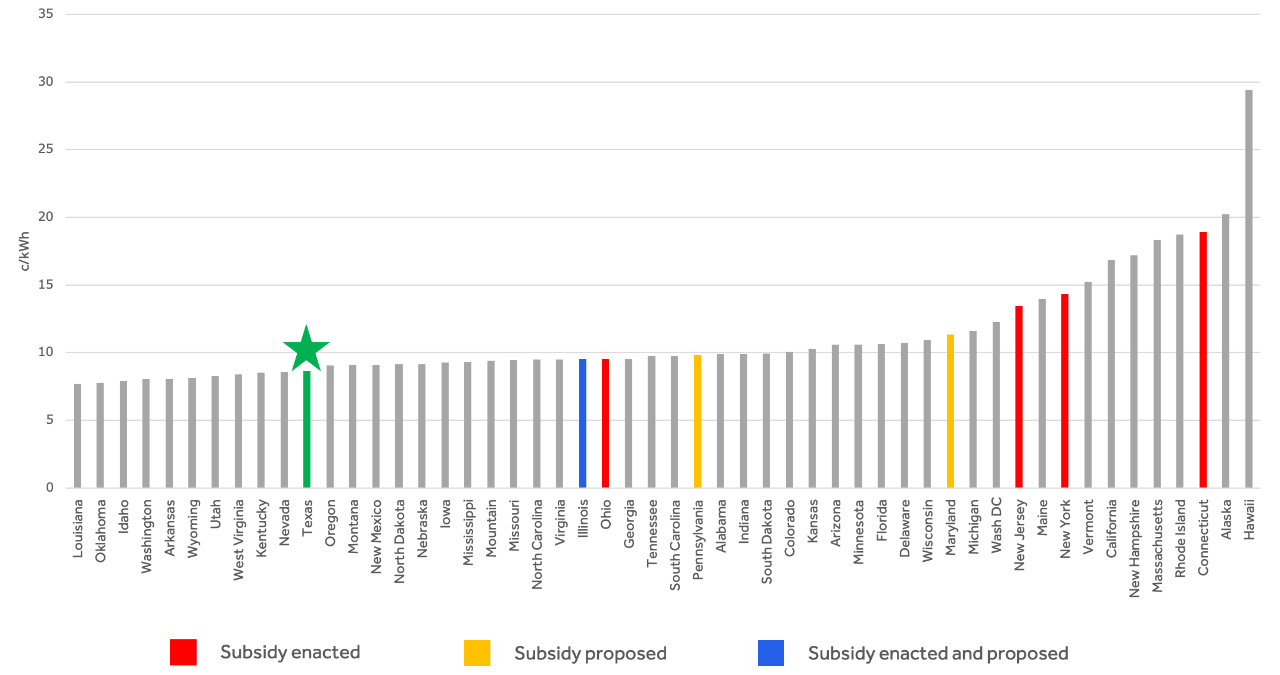
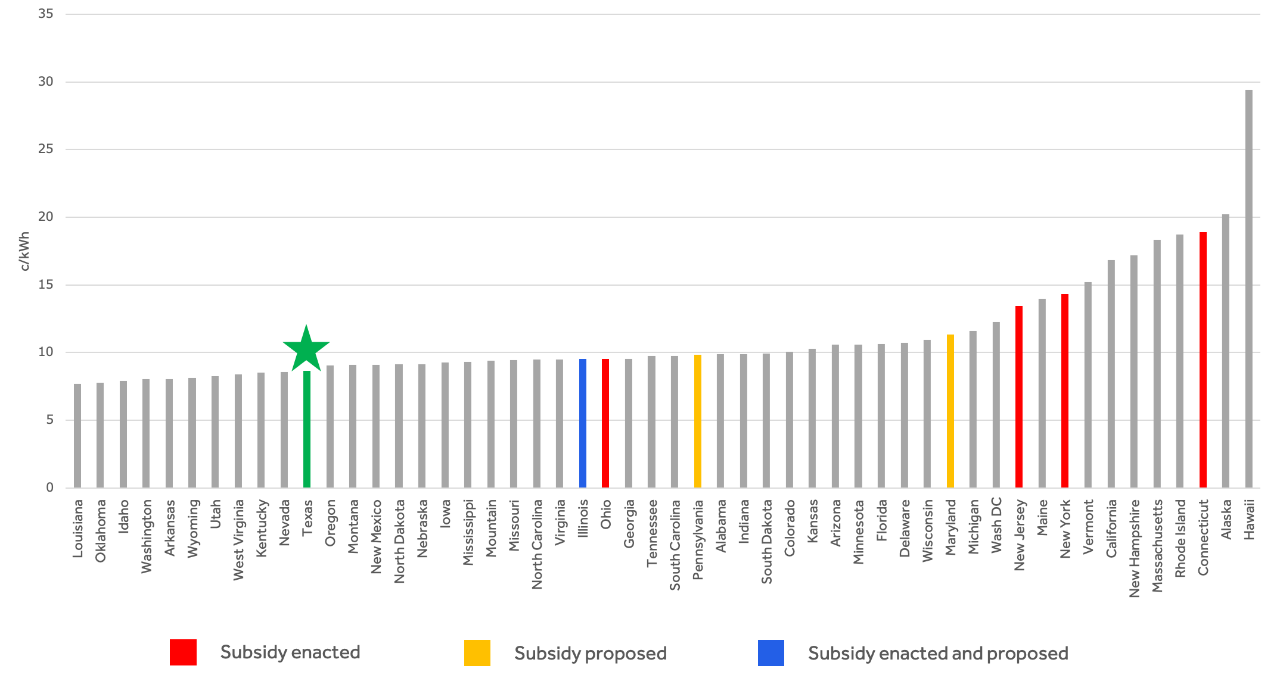
The chart below highlights the average retail cost of electricity by state in 2019. Despite the strong pricing this past summer, Texas remains one of the lowest-cost states in the nation. Its highly competitive market also boasts the highest amount of installed wind generation in the U.S. This compares to states either providing or contemplating nuclear subsidies, which are becoming some of the highest-priced states in the nation. In these states, market subsidies for aging and uneconomic nuclear assets are saddling ratepayers with $17 billion in extra and unnecessary costs over the next decade.
Average Retail Price of Electricity
We believe strongly in the benefits of competitive energy markets. In fact, as states struggle to meet clean energy goals, we’ve introduced the concept of a clean energy market that would incentivize the development of new, clean energy resources by encouraging developers to present the best technologies at the lowest cost to consumers. Conversely, trying to circumvent the market, via subsidies for aging expensive generation, for example, can ultimately hinder exactly what we’re trying to accomplish — a world where energy generation is competitively priced, clean, reliable, and, above all else, well-positioned for the future.


Share on